Top 10 Certification Tracking Metrics Healthcare Organizations Should Monitor
Every certification tracking metric that matters, standardized: what it measures, why it matters, and how to calculate it, plus the operational metrics proactive credentialing leaders also watch.
Healthcare organizations rely on current certifications, licenses, and continuing education records to support regulatory compliance, workforce readiness, and quality patient care. Yet as organizations expand across multiple departments, specialties, and locations, monitoring and planning around these credentials becomes increasingly complex.
Without clear visibility into the certification status of their workforce, healthcare administrators may struggle to identify upcoming expirations, incomplete continuing education requirements, or documentation gaps until an audit, credentialing review, or regulatory inspection brings them to light. In addition to inducing increased operational risk, these gaps can cause administrative delays and compliance concerns, which further burden administrative staff and put the organization in an unfavorable position.
This is where certification tracking metrics become valuable. Rather than simply monitoring expiration dates, organizations can use measurable performance indicators to assess the effectiveness of their certification management processes, identify trends, and proactively address compliance risks before they affect operations.
In this post, we cover the top 10 certification tracking metrics (CTMs) healthcare organizations should monitor for optimal compliance management.
CE Snapshot
The Top 10 Metrics, Standardized: Each certification tracking metric (CTM) is broken down in the same way: what it measures, why it matters, and how to calculate it.
Rooted in Regulation and Practice: The metrics trace to the CMS Conditions of Participation, Joint Commission primary source verification standards, NAMSS credentialing criteria, and federal exclusion screening rules, alongside accepted industry practice.
Beyond Expirables: The operational metrics credentialing leaders also track, from credentialing turnaround time to federal exclusion screening.
Reactive to Proactive: Ad hoc tracking finds compliance gaps during audits; metrics-driven management finds them first.
What Are Certification Tracking Metrics?
Certification tracking metrics (CTMs) are measurable indicators that helphealthcare organizationsevaluate how effectively they manage employeelicenses, certifications, continuing education (CE), continuing medical education (CME), and other professional credentials.
What Value Do Certification Tracking Metrics Have?
By monitoring certification tracking metrics, healthcare organizations can move from reactive credential management to a more proactive compliance strategy. Here’s how:
Healthcare professionals often maintain multiple credentials simultaneously, including professional licenses, specialty certifications, board certifications, mandatory training requirements, and continuing education credits.
Each credential may have a different renewal cycle, documentation requirement, or governing authority, making consistent reporting and record-keeping increasingly challenging as organizations grow.
To give you an idea, here are the current state-by-state CME requirements published by the Federation of State Medical Boards (FSMB), mapping required credit hours and renewal intervals state by state.[1]
Given the complexities, rather than relying solely on manual spreadsheets or periodic reviews, forward-thinking organizations use CTMs to monitor certification status across their workforce in real time. The insights gained help compliance teams identify approaching renewal deadlines, incomplete documentation,overdue training, and other issues that could affect regulatory compliance and workforce readiness.
Let us now further understand how metrics-driven certification tracking aids healthcare organizations.
Ad Hoc Certification Tracking vs. Metrics-Driven Certification Management
At a glance, here are the key differences between ad hoc certification tracking and metrics-driven certification management.
Ad Hoc Certification Tracking
Metrics-Driven Certification Management
Relies on spreadsheets or manual reminders
Uses centralized dashboards and real-time reporting
Limited visibility into upcoming expirations
Continuously monitors certification status
Compliance issues are often discovered during audits
Potential risks identified before audits occur
Time-consuming reporting
Automated compliance reporting
Difficult to monitor large workforces
Scalable across multiple departments and locations
Reactive renewal process
Proactive, metrics-driven renewal management
Why Certification Tracking Metrics Matter for Compliance Management
Healthcare organizations operate within a highly regulated environment where maintaining current certifications is essential for supporting workforce qualifications,credentialing processes, and organizational compliance.
Federal regulations, accreditation standards, and state licensing requirements all emphasize the importance of maintaining appropriate practitioner qualifications and documentation.
For hospitals, for example, the Centers for Medicare & Medicaid Services Conditions of Participation (CMS CoPs) require an organized medical staff that examines the credentials of every candidate for membership (42 CFR 482.22), while the governing body is responsible for appointments and for the credentialing and privileging process (42 CFR 482.12).[2]
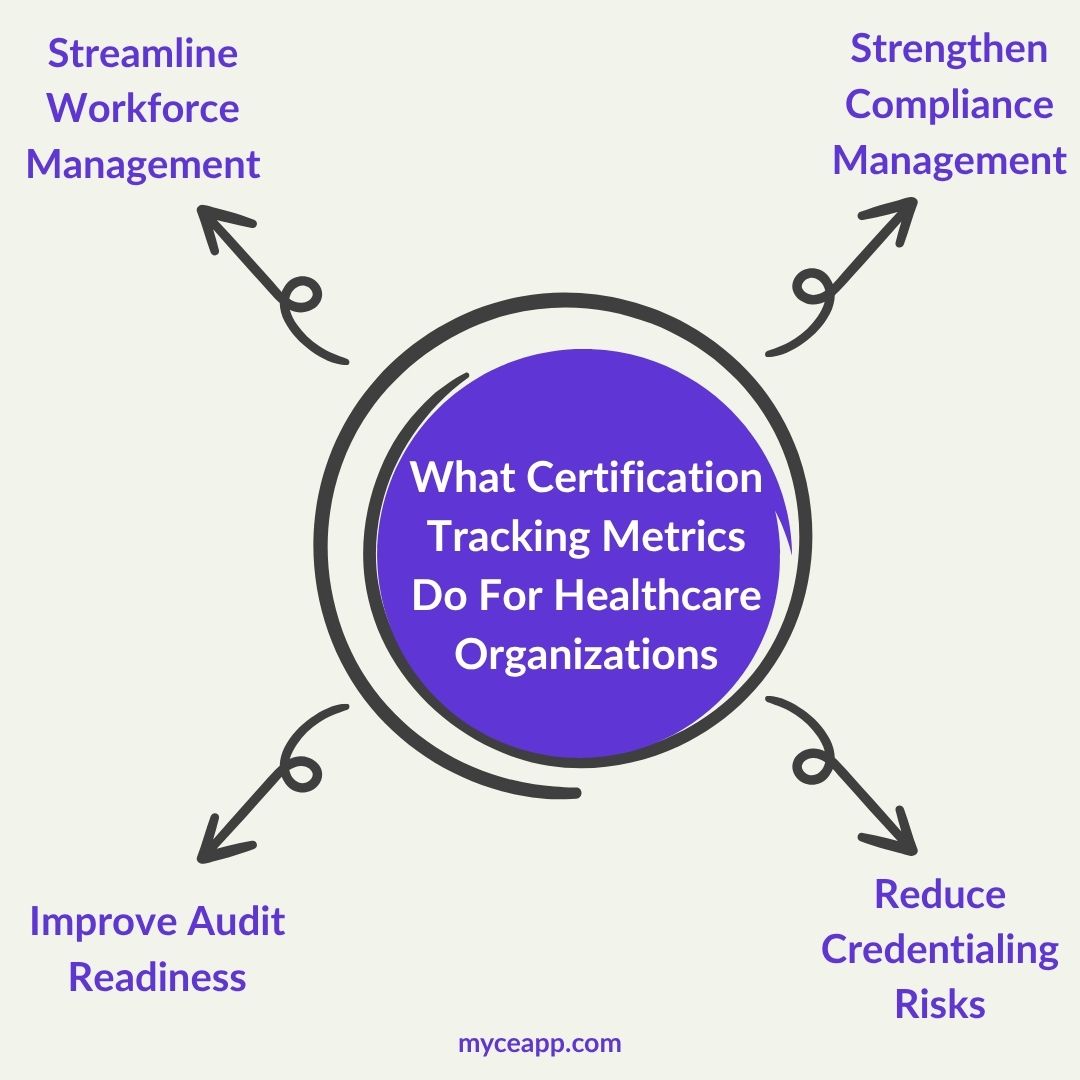
Monitoring CTMs is one of the ways healthcare organizations can stay ahead of the regulators because they help:
Strengthen Compliance Management: Improve healthcare compliance, maintain accurate credential records, and support continuing education requirements.
Reduce Credentialing Risks: Identify certification gaps early to prevent expired credentials and minimize compliance issues.
Improve Audit Readiness: Keep documentation organized and up to date to simplify audits and demonstrate regulatory compliance.
Streamline Workforce Management: Reduce administrative burden while improving workforce planning through centralized certification tracking.
Rather than reacting to missed renewals, organizations can use such performance metrics to identify trends, allocate resources more effectively, and strengthen compliance programs over time.
Top 10 Certification Tracking Metrics Every Healthcare Organization Should Monitor
Each metric below follows the same format: what it measures, why it matters, and how to calculate it.
Certification Expiration Rate
What It Measures: One of the most important certification tracking metrics is the percentage of certifications that expire before renewal.
Why It Matters: A consistently high expiration rate may indicate weaknesses in reminder systems, documentation workflows, or continuing education management. Monitoring this metric allows compliance teams to identify recurring issues and implement corrective actions before they affect workforce compliance.
How To Calculate:
(Certifications that expired before renewal ÷ certifications due for renewal in the period) × 100.
For a point-in-time view: (currently expired certifications ÷ total required certifications) × 100.
Upcoming Certification Renewals
What It Measures: Organizations should continuously monitor how many certifications are approaching expiration within the next 30, 60, or 90 days.
Why It Matters: Advance visibility gives clinicians sufficient time to complete CE or CME requirements, gather supporting documentation, and submit renewal applications. Early intervention significantly reduces the likelihood of unexpected certification lapses.
How To Calculate:
Count the certifications with expiration dates in the next 30, 60, and 90 days, segmented by department or credential type.
As a share: (certifications expiring in the window ÷ total active certifications) × 100.
Continuing Education (CE) Completion Rate
What It Measures: Tracking CE completion rates helps organizations determine whether employees are progressing toward renewal requirements throughout the certification cycle rather than waiting until deadlines approach.
Why It Matters: Many professional licenses and certifications require continuing education for renewal, and the credit totals this metric tracks against vary by profession and state. The American Medical Association’s Ed Hub maintains state-by-state pages pairing each state’s current CME requirements with courses that satisfy them, a practical place to confirm those totals.[3]
How To Calculate:
(CE or CME credits completed ÷ credits required for the current renewal cycle) × 100 per professional.
At the organization level: (staff on track for their cycle ÷ total staff with CE requirements) × 100.
License Renewal Completion Rate
What It Measures: Healthcare license renewal tracking measures the percentage of licenses successfully renewed before expiration across physicians, nurses, allied health professionals, and other clinical staff.
Why It Matters: A high renewal completion rate demonstrates effective certification compliance tracking and supports uninterrupted workforce operations.
How To Calculate:
(Licenses renewed on or before their expiration date ÷ licenses due for renewal in the period) × 100.
Overdue Certifications
What It Measures: Monitoring overdue certifications provides immediate insight into active compliance risks. Where metric #2 looks forward at approaching deadlines, this metric captures what has already lapsed. Organizations should review:
Number of expired certifications
Departments with overdue credentials
Time elapsed since expiration
Outstanding documentation requirements
Why It Matters: This metric helps prioritize remediation efforts and reduce potential audit findings.
How To Calculate:
Count of certifications past their expiration date without a completed renewal, tracked with days elapsed since expiration.
As a rate: (overdue certifications ÷ total required certifications) × 100.
Documentation Completion Rate
What It Measures: Organizations should monitor whether required documentation, including certificates, transcripts, licenses, verification records, and continuing education documentation, has been uploaded and verified.
Why It Matters: Incomplete records may create challenges during audits even when certifications remain active.
How To Calculate:
(Required documents uploaded and verified ÷ total required documents) × 100, tracked per practitioner file and across the organization.
Audit Readiness (File Completeness Rate)
What It Measures: Audit readiness is measured as file completeness: the percentage of practitioner files that hold every element an accreditor requires. Track completeness across current certifications, supporting documentation, primary source verification, CE and CME records, and license verification status.
Why It Matters: National Association Medical Staff Services (NAMSS) standards call for primary source verification (PSV) of the elements supporting the required credentialing criteria within 180 days of review, so file completeness is a direct, defensible readiness measure rather than a subjective score.[4]
The Joint Commission’s Standards Interpretation FAQ on primary source verification makes the stakes plain: completing PSV of licenses, certifications, and registrations is the organization’s responsibility, not the practitioner’s, and the requirements sit in the Human Resources chapter of its accreditation manuals.[5]
How To Calculate:
(Practitioner files containing every required element ÷ total practitioner files) × 100.
Credential Verification Turnaround Time
What It Measures: Tracking the average time required to verify or update credentials helps organizations improve administrative efficiency and reduce onboarding delays.
Why It Matters: Credential verification often requires coordination between healthcare professionals, credentialing teams, licensing boards, and third-party organizations. Lower turnaround times support faster provider credentialing and workforce deployment.
How To Calculate:
Total days from verification request to completed verification ÷ number of verifications completed in the period.
Track the median alongside the average so a few slow files don’t hide the typical experience.
Multi-State License Compliance
What It Measures: Monitoring compliance by jurisdiction helps organizations ensure providers remain compliant with state-specific requirements.
Why It Matters: Healthcare organizations operating across multiple states frequently manage different renewal cycles, continuing education requirements, and licensing regulations. The Federation of State Medical Boards publishes state-specific continuing medical education requirements that highlight these regulatory differences.[1]
How To Calculate:
(Providers fully compliant in a state ÷ providers licensed or practicing in that state) × 100, reported state by state rather than as one blended number.
Mandatory Training Completion Rate
What It Measures: In addition to professional certifications, organizations should monitor required training programs such as infection prevention, workplace safety, privacy, and other regulatory-mandated education.
Why It Matters: The Centers for Disease Control and Prevention (CDC) emphasizes ongoing education and competency-based training as important components of healthcare personnel safety and infection prevention programs.[6] Tracking completion rates helps organizations demonstrate continuing education compliance while reducing operational risk.
How To Calculate:
(Staff who completed the required training ÷ staff assigned the training) × 100, per program and per deadline window.
Additional Operational Metrics Leading Credentialing Teams Track
The ten metrics above cover the expirables side of compliance. Credentialing and compliance leaders increasingly report on a second set of operational metrics alongside them:
Credentialing Turnaround Time (Time to Credential): The number of days from application received to approval for a new provider, which makes it the metric most directly tied to when a hired provider can start seeing patients and generating revenue.
OIG and SAM Exclusion Screening Compliance: The percentage of the workforce screened each month against the U.S. Department of Health and Human Services Office of Inspector General (OIG) exclusion list and the federal System for Award Management (SAM) database. Federal Medicaid screening rules require exclusion database checks no less frequently than monthly (42 CFR 455.436).[7]
Payer Enrollment Status: The share of providers fully enrolled with contracted payers, since an unenrolled provider cannot bill for services.
Common Challenges When Measuring Certification Tracking Metrics
Although CTMs provide valuable insights, collecting accurate data becomes increasingly difficult as organizations grow. Common challenges include:
Manual spreadsheet tracking
Disconnected credentialing systems
Multiple renewal schedules
Limited visibility across departments
Multi-state licensing complexity
Delayed documentation uploads
Administrative workload
Inconsistent reporting processes
These challenges often prevent organizations from obtaining a complete view of workforce compliance, especially when an external audit or credentialing review occurs.
Best Practices for Monitoring Certification Tracking Metrics
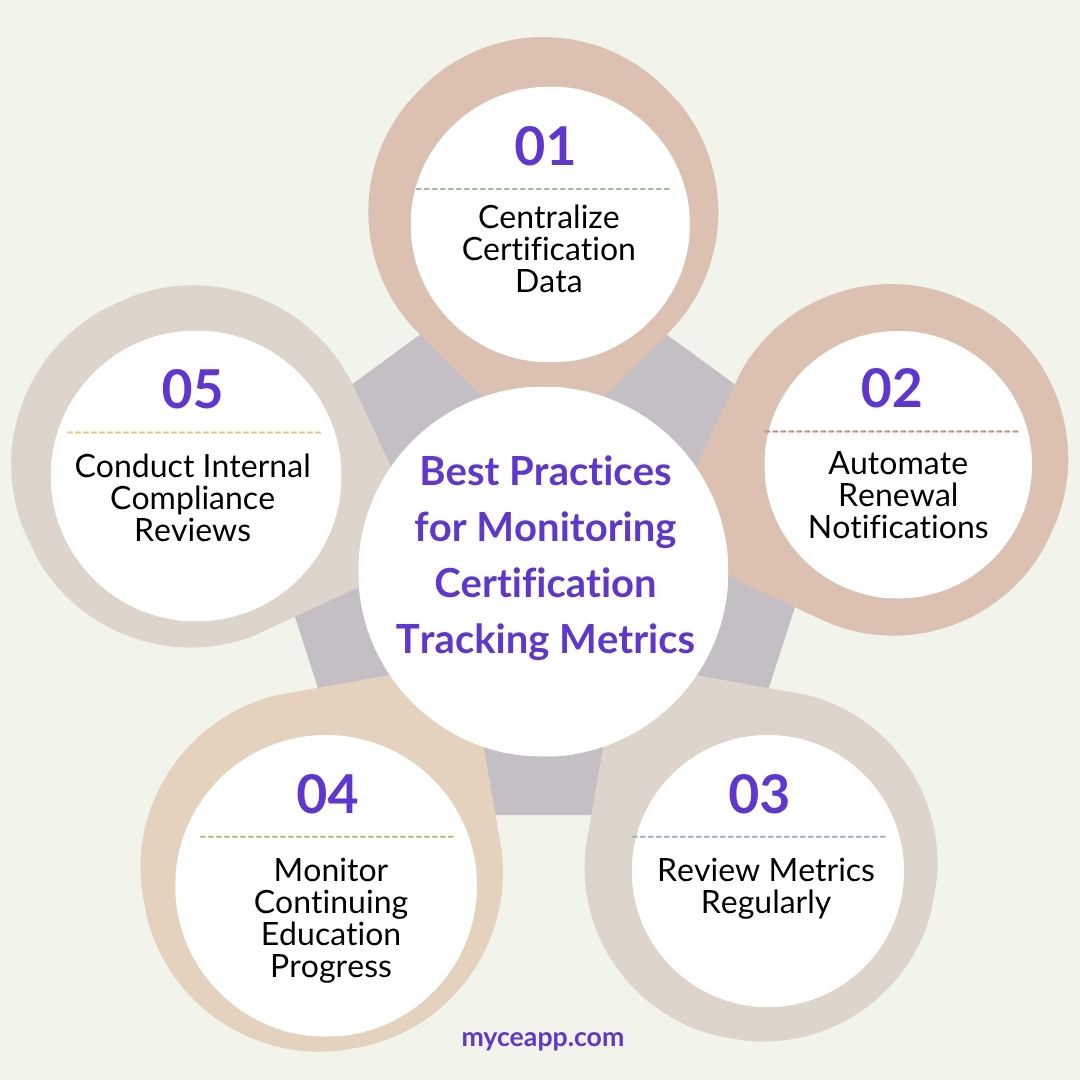
Healthcare organizations can address the challenges by adopting several best practices:
Centralize Certification Data
Maintaining all certification records within a single platform improves visibility across departments and simplifies reporting.
Automate Renewal Notifications
Automated reminders reduce reliance on manual follow-up and help clinicians complete renewals before deadlines.
Review Metrics Regularly
Compliance teams should review certification dashboards routinely to identify trends, upcoming risks, and opportunities for improvement.
Monitor Continuing Education Progress
Tracking CE and CME completion throughout the renewal cycle helps organizations identify gaps early rather than near expiration dates.
Conduct Internal Compliance Reviews
Periodic audits allow organizations to verify documentation, identify inconsistencies, and maintain healthcare audit readiness before external inspections.
How Technology Simplifies Certification Tracking
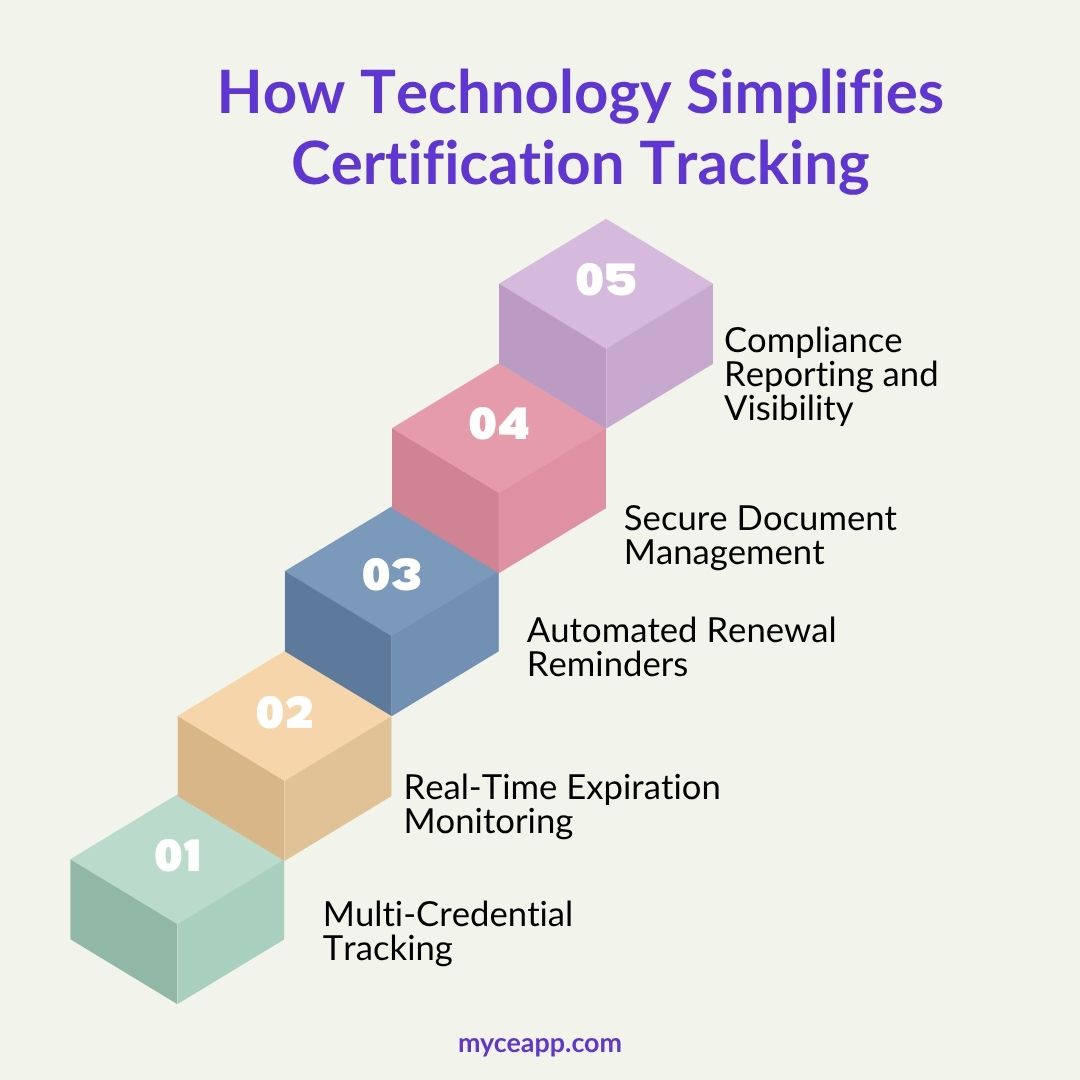
As healthcare workforces expand, ad hoc certification tracking becomes increasingly difficult to sustain. This is where modern certification management platforms can decidedly help organizations:
Multi-Credential Tracking: Track multiple certification types across healthcare professionals, specialties, and departments.
Real-Time Expiration Monitoring: Monitor certification status and expiration dates as they approach.
Automated Renewal Reminders: Send timely notifications to support on-time renewals and reduce administrative effort.
Secure Document Management: Store certification records and supporting documentation in a centralized, secure repository.
Compliance Reporting and Visibility: Generate compliance reports while maintaining organization-wide visibility across departments and locations.
Solutions such as CE App provide healthcare organizations with centralized certification management capabilities that reduce administrative burden while improving compliance visibility.
Instead of relying on disconnected spreadsheets or manual tracking processes, organizations can monitor CTMs from a single platform, helping teams proactively manage renewals, strengthen audit readiness, and support ongoing workforce compliance.
Conclusion
Certification tracking metrics provide healthcare organizations with valuable insight into the effectiveness of their compliance management processes. Rather than simply monitoring expiration dates, these metrics help organizations evaluate workforce readiness, identify potential risks, and strengthen certification compliance tracking across departments and locations.
By monitoring key indicators such as certification expiration rates, CE completion, documentation status, audit readiness, license renewals, and more, healthcare organizations can proactively reduce credentialing risks and improve operational efficiency.
As certification requirements continue to evolve, adopting centralized technology and data-driven certification management practices can help organizations maintain compliance while allowing clinical teams to remain focused on delivering high-quality patient care.
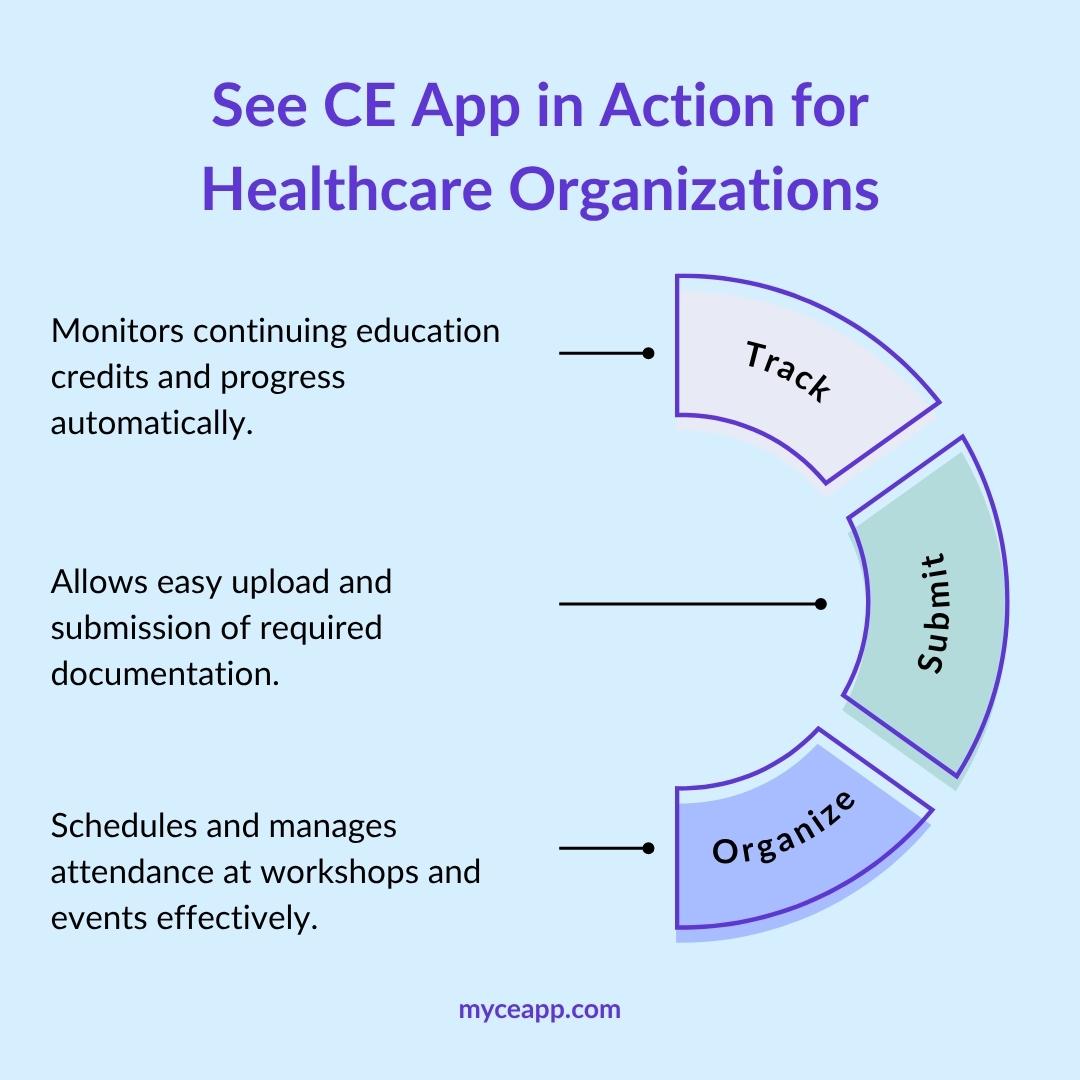
See CE App in Action
Connect with our team today to learn how CE App helps healthcare organizations centralize certification tracking, automate renewal reminders, simplify continuing education management, maintain audit-ready documentation, and gain real-time visibility into workforce compliance.
Disclaimer: This article is for general information and is not legal or compliance advice; confirm requirements with your compliance and legal teams.
Certification tracking metrics are measurable indicators that help healthcare organizations monitor certifications, licenses, continuing education, and credential compliance across their workforce.
Certification tracking metrics (CTMs) improve compliance management by identifying renewal risks, documentation gaps, and credentialing issues before they affect audits, staffing, or regulatory compliance.
Important metrics include certification expiration rates, upcoming renewals, CE/CME completion rates, license renewal completion, documentation completion, audit readiness (file completeness), credential verification turnaround time, mandatory training completion, and credentialing turnaround time for new providers.
Monitoring certification data continuously helps organizations maintain complete documentation, identify missing credentials early, and prepare for regulatory inspections with greater confidence.
Certification management software like CE App centralizes credential records, automates reminders, generates compliance reports, and provides real-time visibility into workforce certification status, reducing administrative workload and supporting ongoing compliance.
Learn more about the CE App
See how your organization can use CE App to increase revenue and improve continuing education compliance.