How the 2025 Government Shutdown Is Exposing the Fragility of Association Compliance Systems
800,000 federal workers are presently furloughed, and compliance oversight is frozen across sectors. Associations using manual CE tracking are facing backlogs, audit gaps, and member confusion. Here's how automation prevents these vulnerabilities.
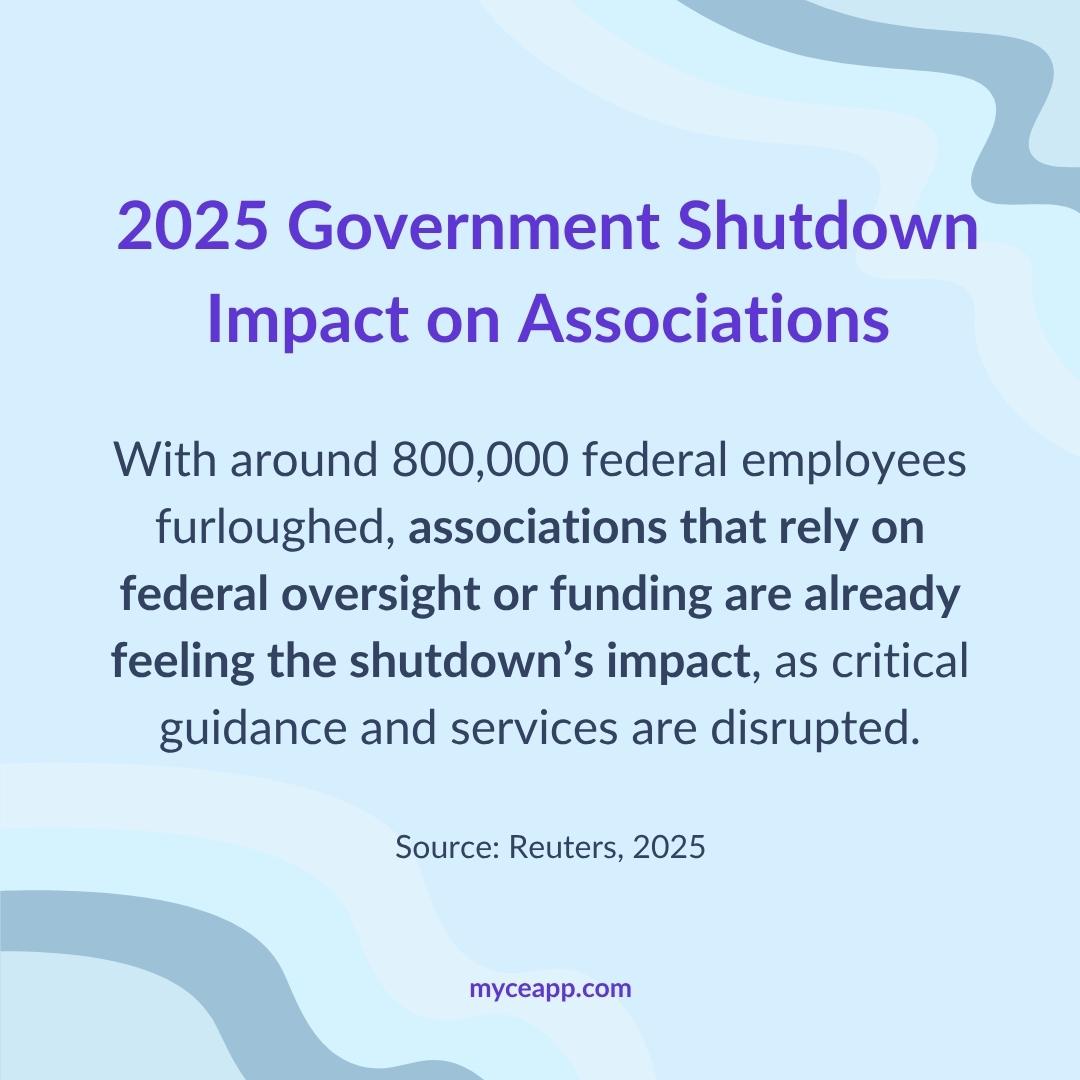
The 2025 government shutdown is in full effect. (Source: Georgia Department of Labor, 2025)1As of publication, around 800,000 federal employees have been ordered not to report to work. (Source: Reuters, 2025)2 If your association depends on federal oversight, funding, or regulatory guidance, you are likely feeling the impact. For professional associations, certification boards, and membership organizations, the impact is immediate, and it's not letting up.
The numbers are stark. CMS has furloughed about 50% of its employees, effectively pausing much of its oversight work. (Source: Reuters, 2025)2HHS has furloughed 41% of staff. CDC? Roughly two out of three workers, or 66%, have been furloughed.2NIH? Three out of four workers, or 75%. (Source: Reuters, 2025)2
And the ripple effects are going way beyond the federal agencies themselves. This shutdown is exposing something that many associations probably didn't want to admit: their compliance systems are fragile. CE (continuing education) compliance, credential tracking, and audit readiness are all more vulnerable than anyone realized.
CE Snapshot
The Crisis: 800,000 federal employees furloughed, freezing CMS, HHS, CDC, and NIH oversight for credential verification and regulatory compliance.
Manual Systems Failing: Associations using spreadsheets and paper-based renewals face growing backlogs, audit trail gaps, and can't scale verification demands.
Automated Systems Thriving: Centralized CE platforms maintain operations, prevent credential lapses, and generate audit documentation independently of federal agencies.
Data Blackout Impact: Bureau of Labor Statistics and Census Bureau suspended releases, eliminating external benchmarks while internal CE analytics become the most reliable truth source.
Claims Processing Delays: CMS holding claims for 10 days creates provider cash flow problems while associations struggle with manual CE verification for reimbursement eligibility.
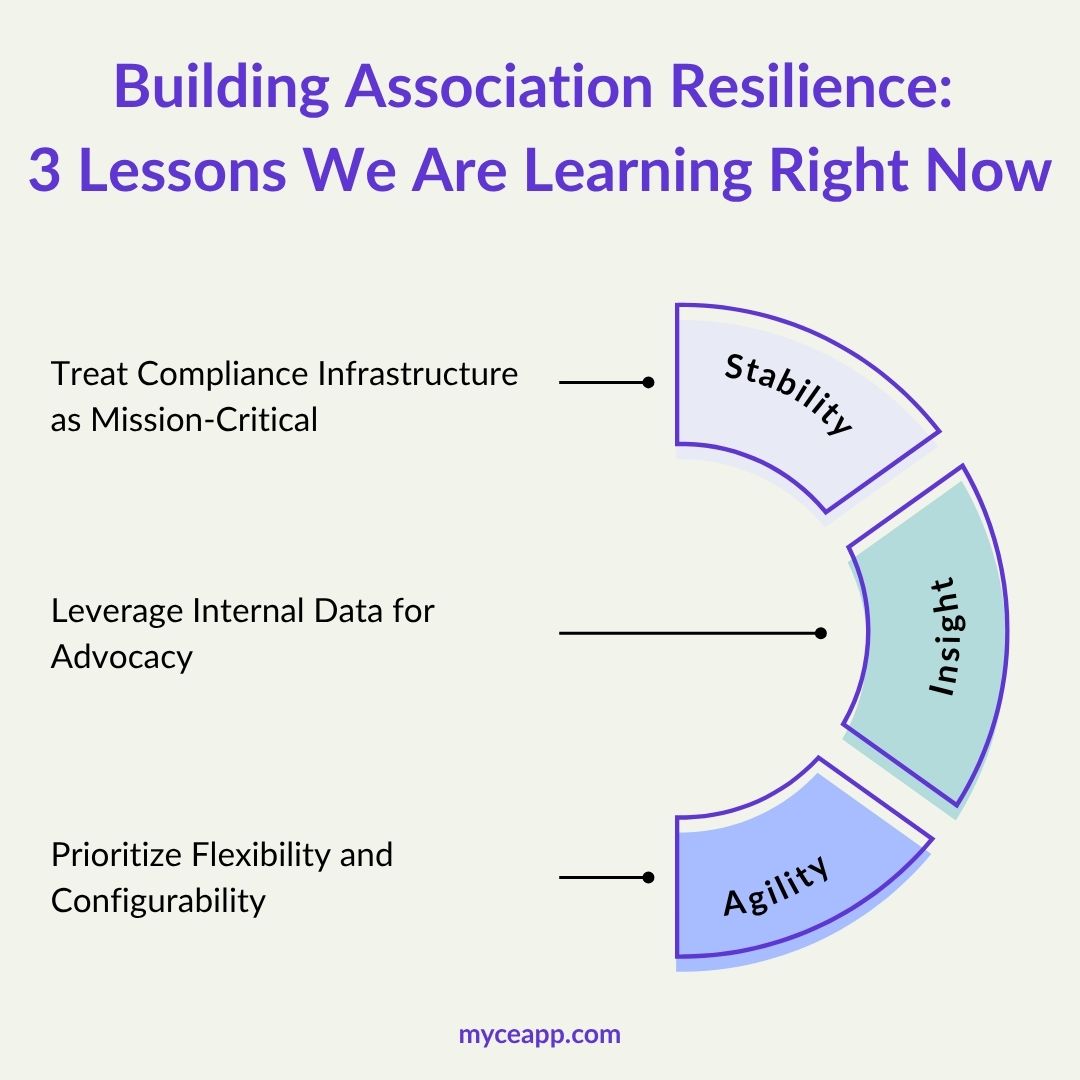
Lesson #1: Treat compliance infrastructure as a mission-critical investment equal to membership databases and financial systems.
Lesson #2: Leverage internal CE participation metrics and credential data for lobbying efforts and stakeholder communication during data freezes.
Lesson #3: Prioritize configurable CE tracking software that adapts policies in hours instead of weeks during rapid disruptions.
The Bottom Line: Automation is the foundation of operational resilience. Associations investing in audit-ready CE tracking now will lead when this crisis ends.
When the System Stops, Can Your Compliance Operations Continue?
Some associations are handling this crisis better than others. The ones weathering it well have one thing in common: they have automated, centralized systems that can keep running while federal agencies go dark.
The ones using manual processes, spreadsheets, and paper-based workflows? They are scrambling. Members are frustrated. Compliance gaps are growing. And nobody knows when this will come to an end.
This isn't just about one shutdown, though. It's bigger than that. It's about how fragile the compliance infrastructure is across the entire association ecosystem. And it's about what you need to do right now to build resilience before things get worse.
Let's examine how this shutdown is creating immediate operational challenges across three critical areas.
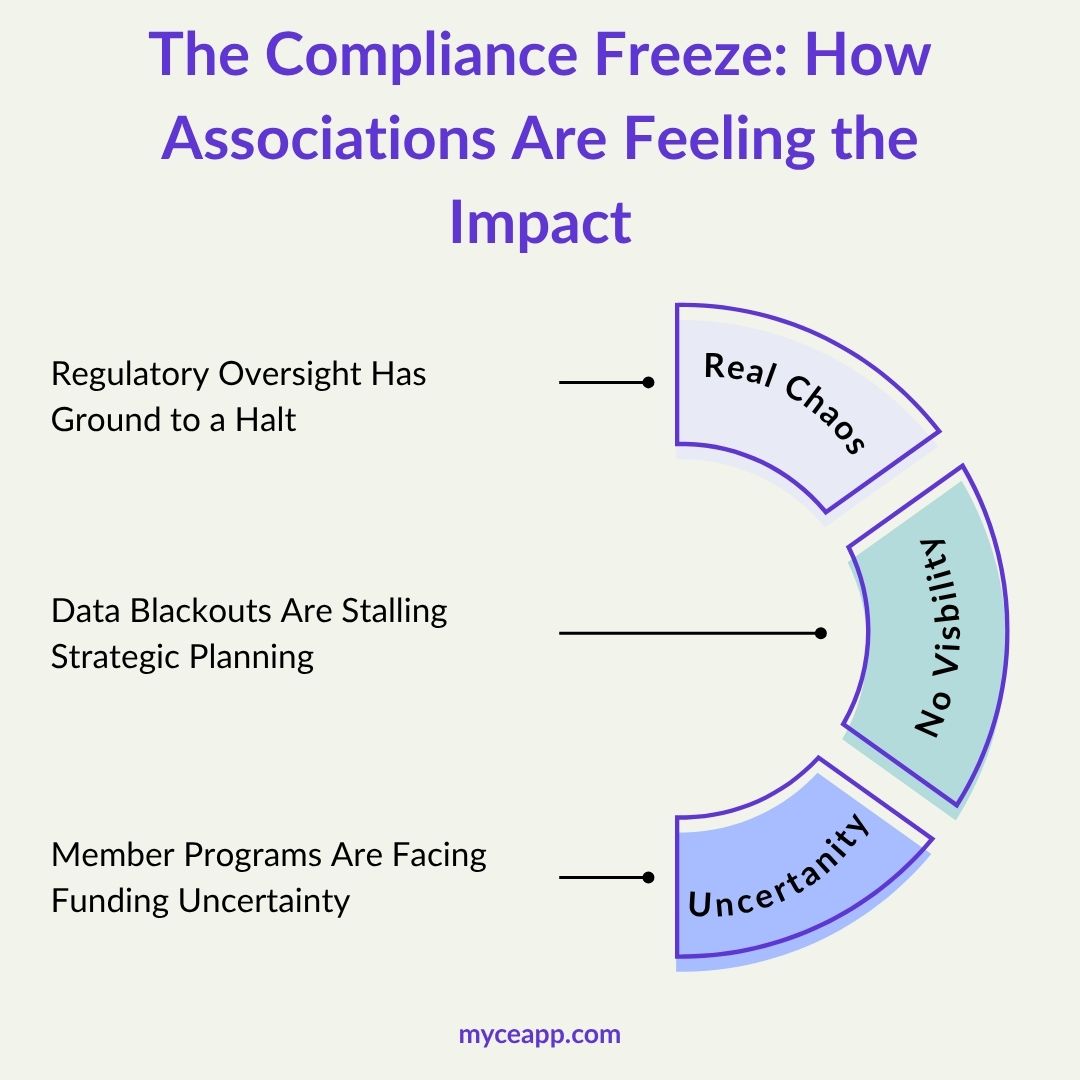
The Compliance Freeze: How Associations Are Feeling the Impact
1. Regulatory Oversight Has Ground to a Halt
Federal agencies that handle oversight, accreditation, and compliance verification are essentially dark. About 91% of the SEC’s total ~4,300 employees are furloughed. (Source: Reuters, 2025)2 Financial filings are stalled. Professional organizations in finance have no idea what's happening with regulatory requirements.
CMS has suspended survey and certification activities. (Source: CMS, 2025)3Healthcare associations can't verify member credentials through normal channels.
And for certification boards? The ones that rely on federal databases for licensure verification or accrediting body approvals? It's a perfect storm brewing. Applications are stalled. Exam scheduling is uncertain. Renewal cycles are backing up. There's no clear timeline for when any of it will get resolved.
2. Data Blackouts Are Stalling Strategic Planning
The Bureau of Labor Statistics and the Census Bureau have suspended data releases. (Source: U.S. Bureau of Labor Statistics, 2025)4All those external benchmarks associations use for workforce analysis, compensation studies, and advocacy efforts are gone.
Government dashboards have stopped updating. Association leaders are losing visibility into market trends that usually inform education programming and policy decisions.
There is one silver lining, though. Organizations that have invested in member education analytics are finding something unexpected. Their internal CE tracking data is becoming the most reliable source of truth about competency trends, training needs, and credential status within their professional communities. While government data is frozen, these associations have their own data to fall back on.
3. Member Programs Are Facing Funding Uncertainty
The National Council of Nonprofits and Independent Sector are warning that member organizations might need to cut services because of funding uncertainty. Grant-dependent associations are facing immediate cash flow problems. (Source: National Council of Nonprofits)5 The ones relying on federal partnerships for educational content development? Programming is delayed indefinitely.
The U.S. Travel Association is calculating a $1 billion weekly economic loss from this shutdown. (Source: U.S. Travel Association, 2025)6 That number keeps growing. But it also shows something important about having your own internal metrics to support advocacy efforts in such uncertain times.
While all associations feel the impact, the ones facing the most severe challenges share a common weakness: outdated compliance infrastructure.
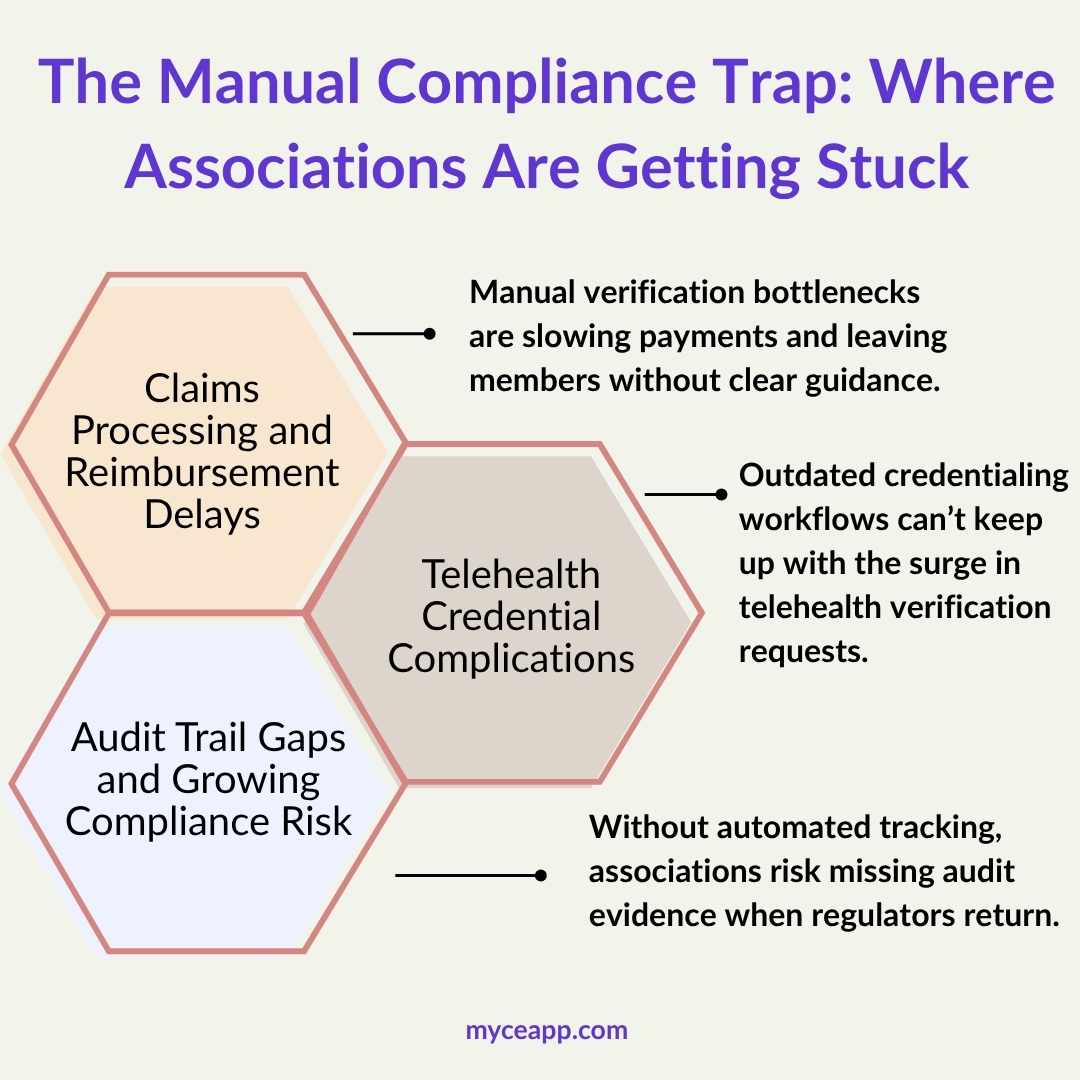
The Manual Compliance Trap: Where Associations Are Getting Stuck
This shutdown is making something painfully clear: associations running on manual compliance workflows are uniquely vulnerable. Here is what's breaking down as the crisis continues.
Claims Processing and Reimbursement Delays
CMS has instructed its Medicare Administrative Contractors to temporarily hold claims for a period of 10 days. (Source: American Society of Anesthesiologists, 2025)7 This creates immediate cash flow problems for healthcare providers and leaves associations that manage CE for reimbursement eligibility scrambling to advise their members.
Without automated systems to track training completion, association staff are forced to attempt manual credential verification while the normal federal channels are closed. This challenge intensifies with each passing day as backlogs compound.
Telehealth Credential Complications
Telehealth privileges for many clinicians ended on October 1, 2025, right when this shutdown started. (Source: HHS.gov, 2025)8 Thousands of healthcare professionals suddenly had to prove they met new geographic and credentialing requirements.
Certification boards overseeing telehealth qualifications are seeing a surge in verification requests right now. And the timing couldn't be worse, with federal databases unavailable, manual processes can't scale to meet the demand.
Audit Trail Gaps and Growing Compliance Risk
Policy development has stopped. Rulemaking activities are halted. Associations don't know what's coming next with compliance changes.
Organizations without automated CE tracking systems can't generate documentation to demonstrate due diligence. What happens if audits resume unexpectedly and you can't show what you've been doing during the shutdown? That's becoming a real problem as this drags on.
The most vulnerable associations have some common characteristics:
CE credits tracked in spreadsheets, scattered across multiple departments, no central system.
Manual certificate collection, where staff have to chase down members for documentation.
Paper-based renewal processes that depend on physical mail and in-person verification.
No automated audit trails showing who completed what training when.
Disconnected Systems: membership data here, CE records there, credential status somewhere else.
So what separates the associations that are thriving from those barely surviving? The answer lies in their infrastructure.
Why Automation Is Preventing Backlog: The Operational Advantage
The associations that are keeping things running during this shutdown have different infrastructure. They are using certification board software and automated CE tracking that can work independently while federal agencies are unavailable.
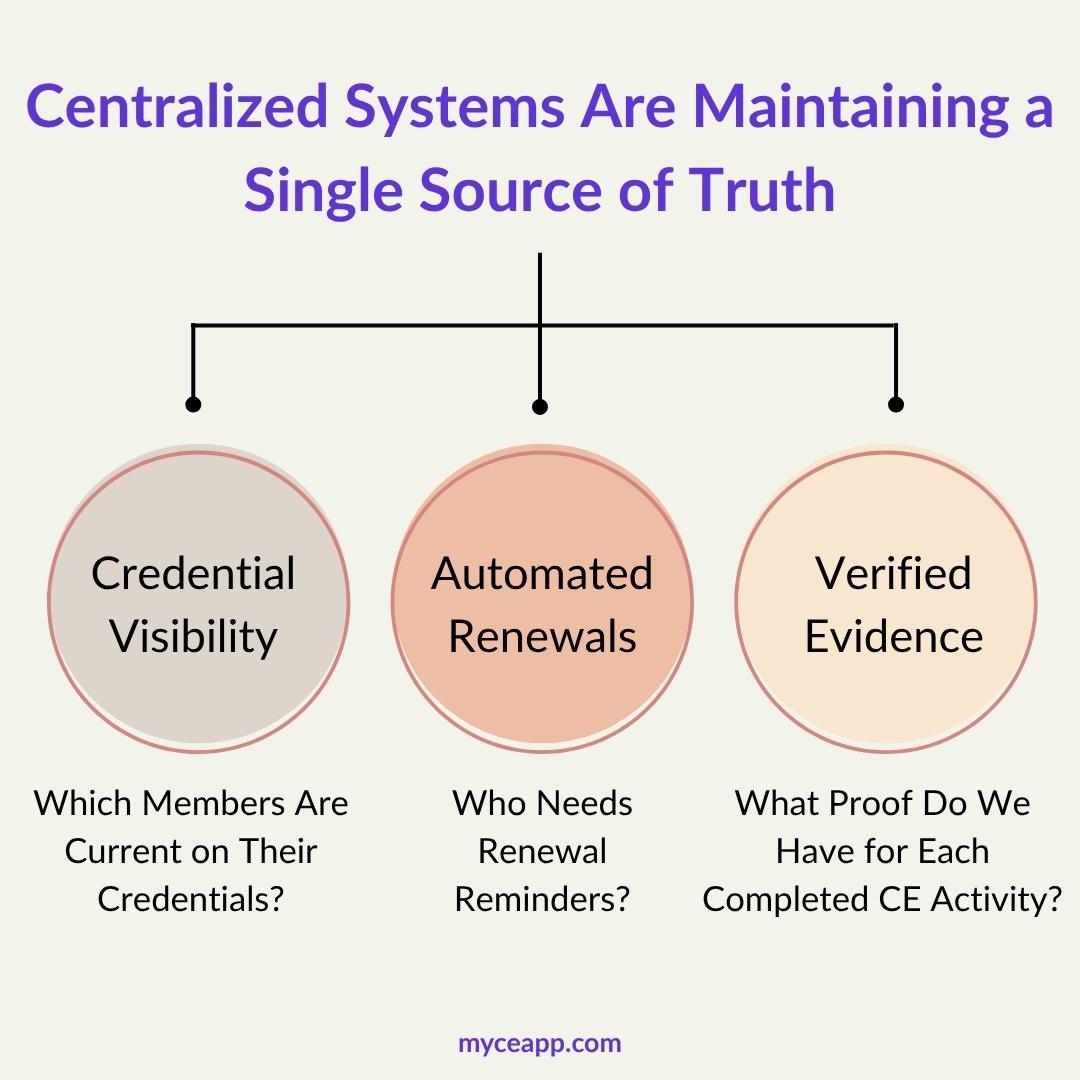
Centralized Systems Are Maintaining a Single Source of Truth
While government databases are offline, associations with centralized CE platforms can still answer the important questions:
Which members are current on their credentials?
Who needs renewal reminders?
What evidence do we have for each completed CE activity?
Automated systems are aggregating CE certificates, tracking credits against requirements, and maintaining timestamped audit logs. When your automations are set up right, you end up with an internal compliance record that doesn't depend on external verification. While the external systems are down, your association still continues to operate.
Intelligent Workflows Are Preventing Member Lapses
Federal agencies have suspended normal operations. But automated CE platforms are still working. Renewal reminders are going out. Upcoming deadlines are getting flagged. Members are getting alerts about incomplete requirements.
Member education analytics are identifying at-risk learners before their credentials lapse. That means associations can do proactive outreach while a lot of members are dealing with their own shutdown-related problems.
Associations using automation are reporting significantly lower rates of accidental credential expiration compared to the ones doing manual tracking. And that matters a lot when reinstatement processes are also delayed by federal furloughs.
Audit Readiness Is Becoming a Competitive Moat
This shutdown is proving something else too. Audit-ready CE tracking isn't just about compliance. It's about operational resilience. Organizations with comprehensive audit trails can demonstrate continuous compliance even while regulators can't actively oversee operations.
These organizations can generate evidence on demand for any member, any certification, any time period. By doing so, they are also maintaining stakeholder confidence by showing systematic, verifiable processes. And when federal agencies reopen? They will be able to resume normal operations immediately. No months of backlog work.
Building Association Resilience: 3 Lessons We Are Learning Right Now
This shutdown is offering some strategic lessons for association leaders who need to act fast:
Lesson #1: Treat Compliance Infrastructure as Mission-Critical
Organizations that saw CE tracking as just an administrative task? They are struggling immensely. The ones that recognized it as mission-critical infrastructure, something that deserves the same investment as membership databases and financial systems, are maintaining operations.
Association CE reporting is becoming way more valuable during this disruption. The ability to instantly generate compliance reports, credential status summaries, and training completion data has gone from a nice-to-have to an absolute necessity.
Lesson #2: Leverage Internal Data for Advocacy
While external data sources are frozen, associations with strong member education analytics are discovering they have powerful advocacy tools they didn't fully appreciate before. Detailed CE participation metrics, competency trend analyses, and credential status reports are becoming the evidence base for lobbying efforts, grant applications, and stakeholder communication happening now.
The U.S. Travel Association is using that $1 billion weekly loss figure to strengthen advocacy. Associations can do the same thing with internal CE data to show how this shutdown is impacting their professional communities.
Lesson #3: Prioritize Flexibility and Configurability
This shutdown is creating operational challenges that need rapid policy adjustments. Extended grace periods. Modified renewal cycles. Alternative verification methods.
Associations using flexible CE tracking software can reconfigure rules and workflows quickly. The ones stuck in manual processes? They are taking weeks to implement simple changes while members are waiting in the dark.
These three lessons point to a clear path forward. Let's examine how the right technology platform addresses each of these imperatives, and why CE App was built specifically for this moment.
Cloud-based systems like CE App with configurable business rules are letting associations adapt policies in hours instead of months. That matters when member needs and regulatory guidance are shifting every day.
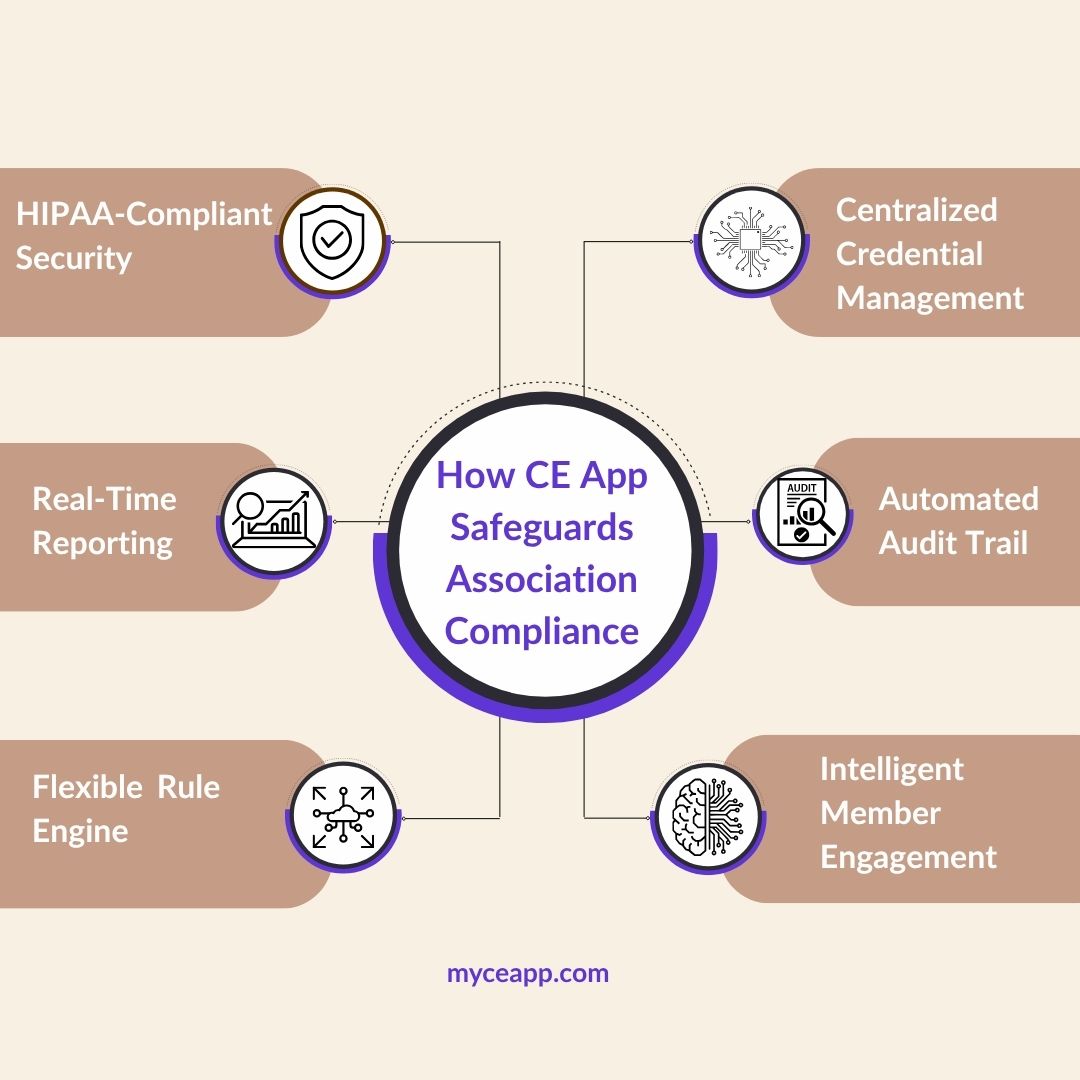
How CE App Safeguards Association Compliance
CE App was designed to eliminate the very weaknesses this shutdown has brought to light. Here’s how our custom solutions are helping associations and certifying associations stay resilient and fully operational through the crisis.
Centralized Credential Management
All CE records, certificates, and credential statuses live in one cloud-based system of record. While external verification sources are down, associations still have complete visibility into member compliance.
Automated Audit Trail
Every CE activity generates a timestamped, immutable record. Who completed what training, when, under which version of requirements? You get documentation to demonstrate continuous compliance even while regulatory oversight is suspended.
Intelligent Member Engagement
Automated workflows send personalized reminders based on individual credential timelines, upcoming expirations, and incomplete requirements. Member education analytics identify patterns that predict lapses so you can intervene before credentials expire during this uncertain period.
Flexible Rule Engine
Configure and reconfigure CE requirements, grace periods, and verification processes without IT support. Respond to policy changes in hours, not weeks. Members always understand current requirements even as things shift.
Real-Time Reporting
Generate compliance reports, renewal forecasts, and credential status summaries instantly. For individual members, cohorts, your entire organization. Use internal data for advocacy, strategic planning, stakeholder communication while government data is frozen.
HIPAA-Compliant Security
Healthcare associations get enterprise-grade data protection meeting HIPAA/HITECH requirements. Sensitive credential information stays secure during this crisis.
Right Now: From Crisis to Competitive Advantage
Let’s recap the critical points we discussed in this post.
The Situation
This 2025 government shutdown is revealing an uncomfortable truth: manual compliance processes create organizational fragility. Associations relying on federal agency availability, paper-based verification, and on spreadsheet tracking are facing backlogs that grow every single day.
The Turning Point
This crisis is showing a clear divide.
Manual systems and associations that rely on themare breaking down.
Whereas automated, centralized CE tracking systems are continuing to operate normally. Forward-thinking associations are thus maintaining member confidence, demonstrating continuous compliance, and strengthening their infrastructure while others struggle.
The Reality
No one knows how long this shutdown will last. It could be days, weeks, or longer. And it will not be the last disruption. Federal funding gaps, regulatory transitions, and compliance delays are inevitable.
The Opportunity
Automation is no longer a luxury. It is the foundation of resilience.
Associations that invest in audit-ready CE tracking and automated credential management now will be the ones leading their professions when this crisis ends.
Ready to Build Compliance Resilience Now?
→ Schedule A Custom Demo: Connect with our team to see how CE App's platform can eliminate the compliance backlogs you are dealing with right now and create audit-ready workflows for your association.
→ Book a Free CE Strategy Session (Worth $2,500): Schedule a comprehensive consultation with our compliance experts. Our industry experts will analyze your current CE infrastructure, identify the vulnerabilities this shutdown is exposing, and design a resilience roadmap you can implement immediately.
Don't let this crisis expose more gaps in your compliance operations. Reach out to our experts and build resilience today.
Frequently Asked Questions
Need help? Start here for fast solutions.
Federal agency furloughs have frozen regulatory oversight, credential verification, and data reporting, creating immediate compliance gaps for associations that rely on manual CE tracking systems.
Associations with automated, centralized CE tracking systems can maintain operations independently, while those using manual processes and spreadsheets are facing growing backlogs and member frustration.
Associations without automated systems struggle to verify credentials, process renewals, and maintain audit trails, creating compliance risk that grows with each day the shutdown continues.
With 50% of CMS staff furloughed and claims processing delayed, healthcare associations face credential verification challenges and reimbursement complications for members who need CE documentation.
Organizations with automated CE tracking can generate comprehensive audit trails independently, while manual systems create documentation gaps that become problematic when agencies resume oversight.
Associations relying on spreadsheet-based CE tracking, manual certificate collection, and paper-based workflows can't scale to meet verification demands when normal federal channels are unavailable.
Automated systems like CE App maintain centralized records, send intelligent renewal reminders, and generate audit documentation continuously regardless of external agency availability.
Invest in centralized CE tracking infrastructure that operates independently of federal oversight, leverage internal data for advocacy, and implement flexible systems that adapt quickly to policy changes.
Learn more about the CE App
See how your organization can use CE App to increase revenue and improve continuing education compliance.