Healthcare Credential Tracking Software: A Complete Guide
A complete guide to healthcare credential tracking software: what it tracks, who should use it, the regulations behind credentialing, and how to choose the right platform.
Healthcare administrators are responsible for tracking professional licenses, board certifications, continuing education requirements, and other workforce credentials, each with its own renewal cycle and documentation requirements.
Managing those credentials becomes more complex as organizations expand across specialties, locations, and regulatory jurisdictions.
Many organizations start with spreadsheets. Spreadsheets work for a small team, but they don’t scale: as the workforce grows, they contribute to missed renewal deadlines, incomplete documentation, and limited visibility.
This is where specialized healthcare credential tracking software helps organizations simplify administrative processes, strengthen compliance efforts, and maintain accurate credential records across the organization.
In this comprehensive guide, we explore what healthcare credential tracking software is, what it tracks, why healthcare organizations invest in credential tracking software, and the key capabilities to look for when evaluating a solution.
CE Snapshot: Healthcare Credential Tracking Software
The Problem: Managing credentials becomes increasingly complex as healthcare organizations expand across specialties, locations, and regulatory jurisdictions.
Centralized Credential Tracking: Credential tracking software helps healthcare organizations monitor and manage licenses, certifications, continuing education requirements, and supporting documentation from a single platform.
Improved Compliance Visibility: Automated reminders and centralized records help reduce the risk of missed renewal deadlines and incomplete documentation.
Greater Operational Efficiency: Replacing manual tracking processes with automated workflows allows credentialing teams to spend less time on administrative tasks and more time on strategic initiatives.
Supports Organizational Growth: As healthcare organizations expand across departments and locations, healthcare credential tracking software provides the visibility and scalability needed to manage workforce credentials effectively.
What Is Healthcare Credential Tracking Software?
Healthcare credential tracking software is a centralized digital solution that allows healthcare organizations to monitor, manage, and maintain workforce credentials throughout their lifecycle.
How Credential Tracking Software Helps Healthcare Organizations
Healthcare professionals must maintain multiple credentials, including professional licenses, specialty certifications, and continuing education requirements. Each may have different renewal deadlines and documentation requirements depending on the profession, specialty, and state.
For example, the Federation of State Medical Boards (FSMB) publishes state-by-state continuing medical education (CME) requirements, showing how required credit hours and renewal intervals vary across jurisdictions.[1]
The volume of continuing education to account for is substantial, too. The Accreditation Council for Continuing Medical Education (ACCME) reports that jointly accredited providers alone delivered 123,175 interprofessional continuing education activities in 2024, up from 113,934 in 2023, reaching nearly 34 million learner interactions.[2]
For healthcare organizations, especially those operating across multiple states, tracking these requirements manually can lead to missed deadlines, incomplete records, and additional administrative work.
Healthcare credential tracking software addresses these challenges by centralizing credential records, tracking renewal dates, and helping administrators monitor credential status across the workforce.
With credential tracking software, healthcare organizations can more easily identify upcoming expirations, locate supporting documentation, and keep credential records organized.
Before we dig deeper, let’s review the two primary approaches healthcare organizations can use to track credentials.
Manual Credential Tracking vs Credential Tracking Software
Healthcare organizations often begin by managing workforce credentials through spreadsheets, shared calendars, or paper-based records. While these methods may work for smaller teams, they become harder to maintain as organizations expand across departments, facilities, and regulatory jurisdictions.
The main difference lies in how credential-related tasks are managed:
Manual Credential Tracking: Manual tracking requires staff to review records, follow up with providers, update status changes, and prepare reports themselves.
Credential Tracking Software: Credential tracking software can automate routine tasks, flag outstanding requirements, and help teams prioritize actions that demand attention.
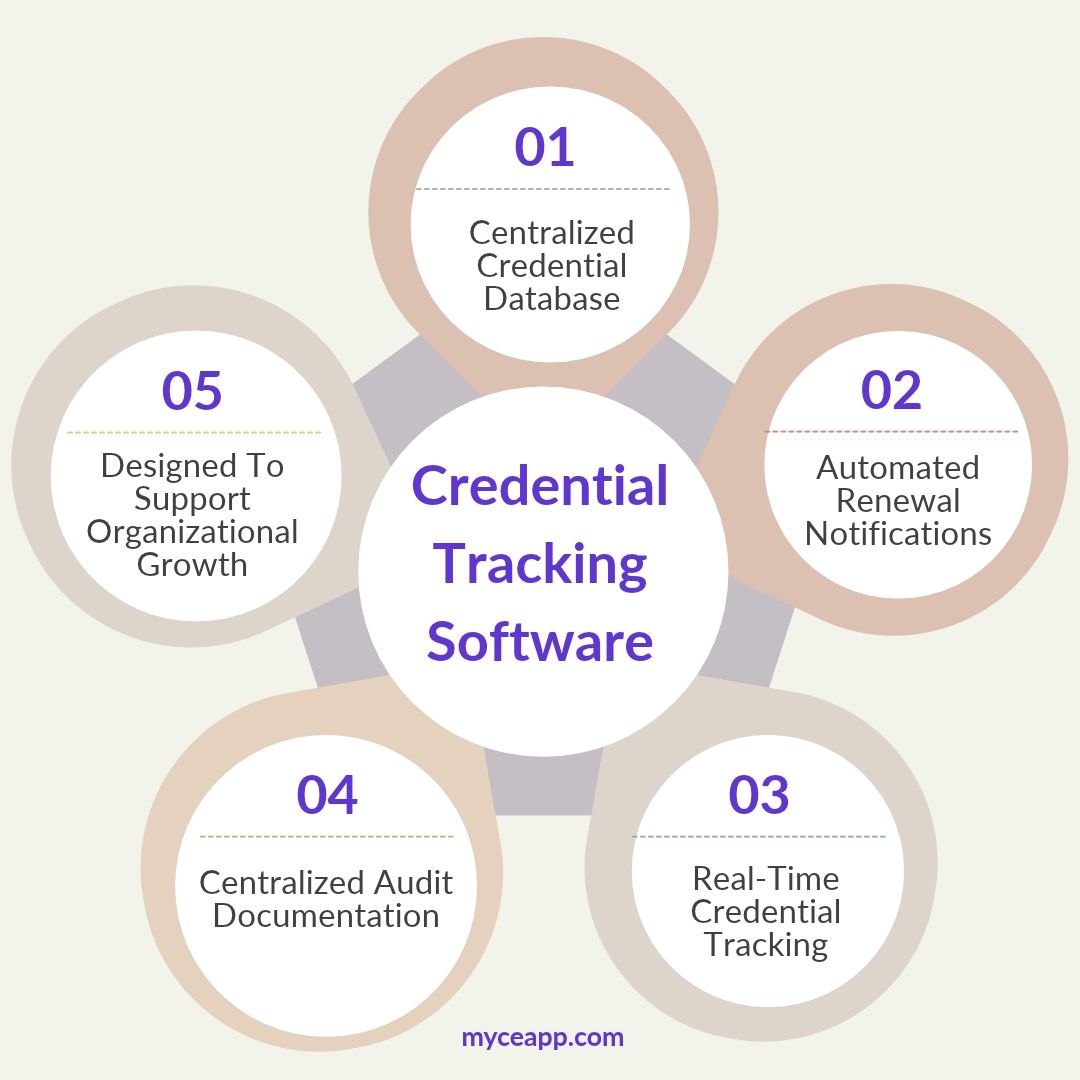
At a glance, here are the key differences between manual credential tracking and credential tracking software:
Manual Credential Tracking
Credential Tracking Software
Multiple Spreadsheets or Paper Records
Centralized Credential Database
Manual Reminders and Follow-Ups
Automated Renewal Notifications
Limited Visibility into Credential Status
Real-Time Credential Tracking
Time-Intensive Audit Preparation
Centralized Audit Documentation
Difficult to Scale Across Multiple Facilities
Designed to Support Organizational Growth
As healthcare organizations expand, a centralized credential tracking system helps organizations maintain consistent credential records while improving collaboration between credentialing teams, compliance officers, human resources, and department leadership.
Ready to Move Beyond Spreadsheets?
See how CE App helps healthcare organizations centralize credential tracking, automate renewal reminders, and stay audit-ready from one platform. → Book a Demo Today
Let’s explore the most common challenges organizations face with manual credential tracking.
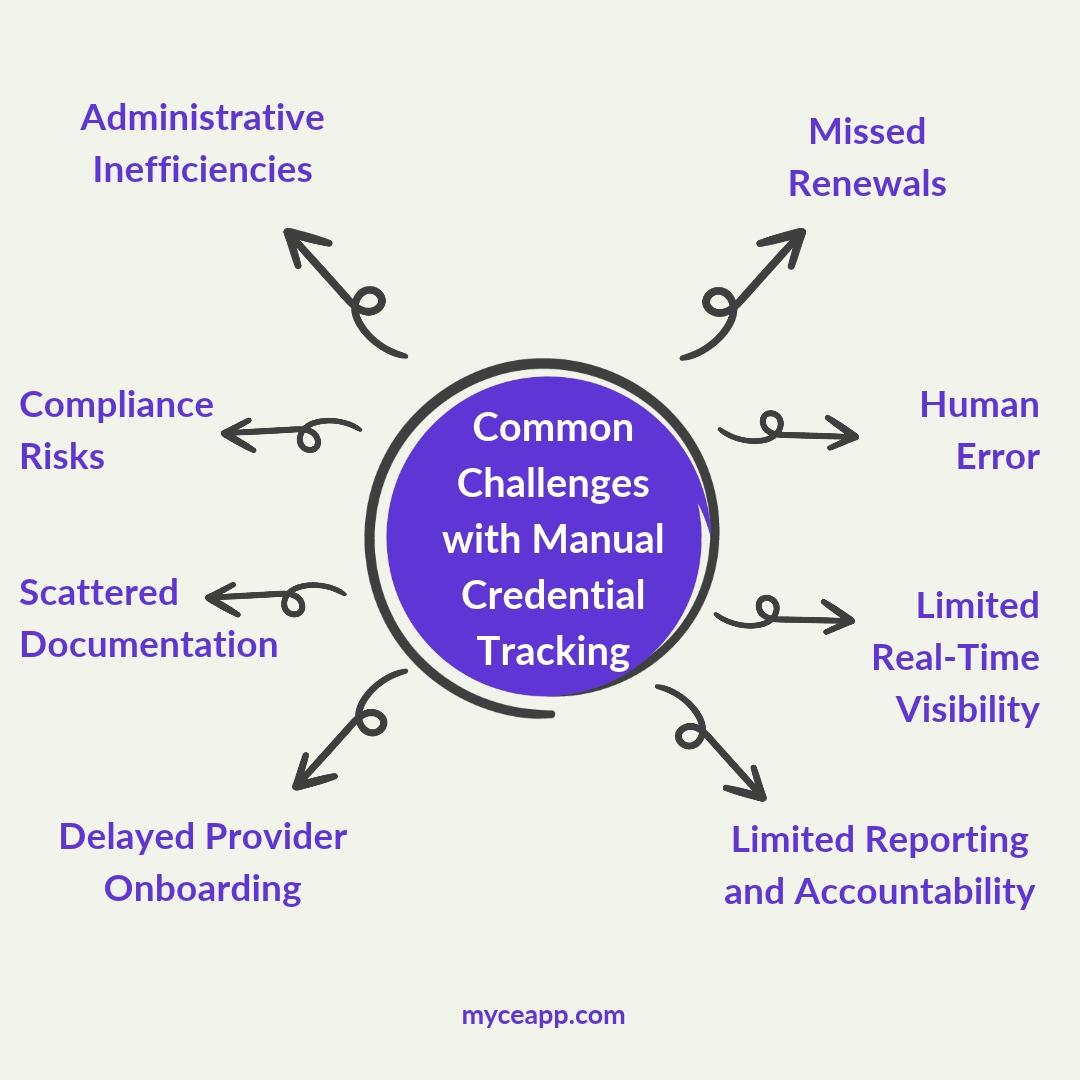
Common Challenges with Manual Credential Tracking
Healthcare organizations relying on spreadsheets or manual processes often face several operational challenges as workforce size and regulatory requirements increase. The most common challenges include:
Administrative Inefficiencies: Managing providers across multiple locations, tracking credential status, and preparing for audits can consume significant administrative time and drain resources.
Missed Renewals: Manual tracking makes it easier to overlook upcoming license, certification, or continuing education deadlines, leading to missed renewals.
Compliance Risks: Missing, outdated, or incomplete documentation makes it harder to demonstrate that providers meet applicable requirements, contributing to the organization’s compliance exposure.
Human Error: Spreadsheet errors, duplicate records, and inconsistent data entry can lead to inaccurate credential information, muddying the data organizations rely on.
Scattered Documentation: Storing records across emails, shared drives, paper files, and spreadsheets makes documents harder to locate and verify, leaving no single source of truth.
Limited Real-Time Visibility: Without a centralized tracking system, administrators may struggle to identify expired credentials, outstanding verifications, and incomplete provider documentation when timelines are squeezed or an audit is approaching.
Delayed Provider Onboarding: Missing documents and manual verification workflows can slow credentialing and delay providers from completing onboarding requirements, potentially resulting in lost revenue for the organization.
Limited Reporting and Accountability: Preparing compliance reports and reviewing credential history can require manual work, especially when multiple departments maintain separate records across jurisdictions and practice areas.
Let’s explore what such software tracks.
What Does Credential Tracking Software Track?
Modern credential tracking software tracks much more than professional licenses. It gives healthcare organizations acomprehensiveviewofworkforcequalificationsby centralizing multiple credential types in a single platform.
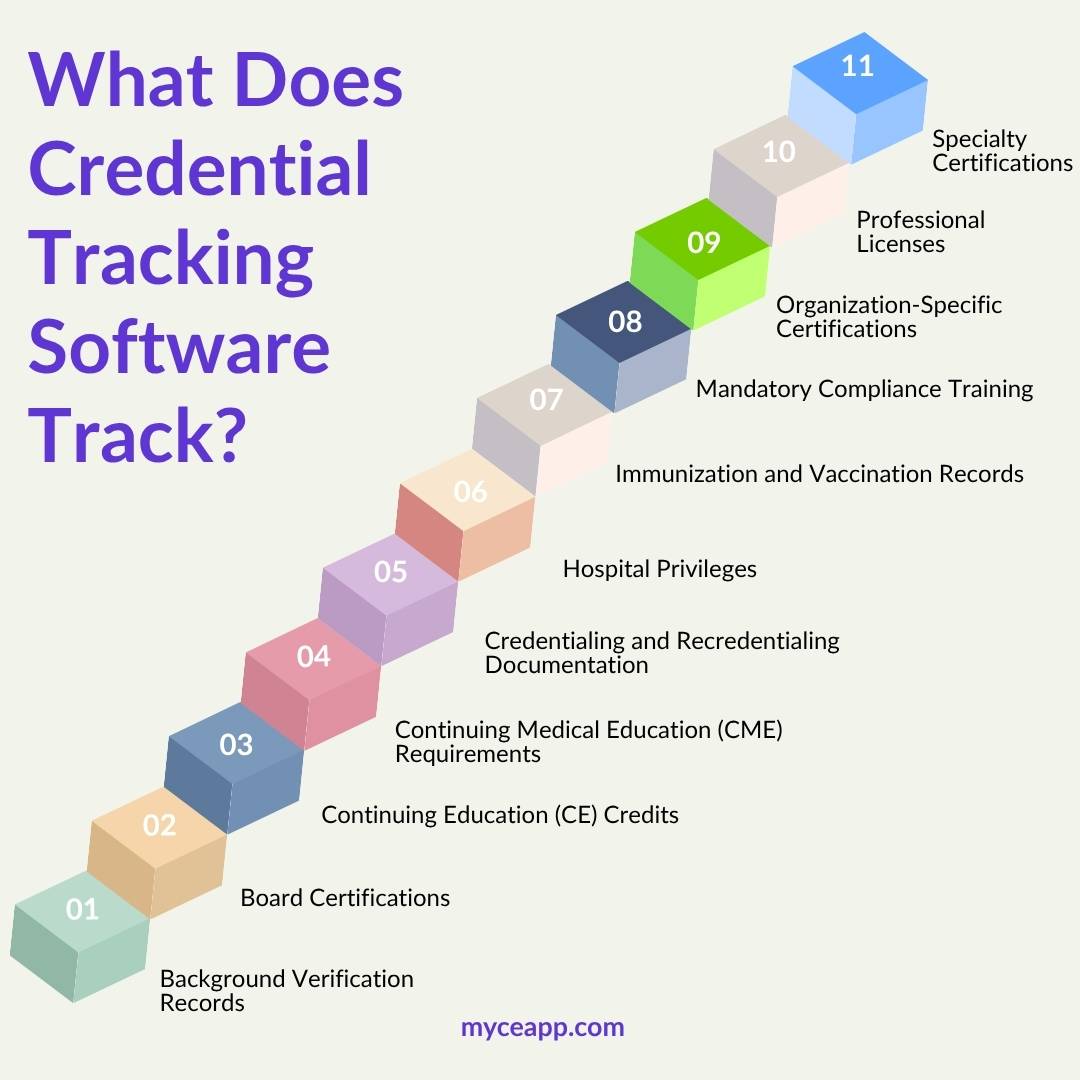
Depending on the organization, credential tracking software may track:
Background Verification Records
Board Certifications
Continuing Education (CE) Credits
Continuing Medical Education (CME) Requirements
Credentialing and Recredentialing Documentation
Hospital Privileges
Immunization and Vaccination Records, where applicable
Mandatory Compliance Training
Organization-Specific Certifications
Professional Licenses
Specialty Certifications
The above list is not exhaustive, and tracking these records helps healthcare organizations identify missing or expired credentials. It also supports the primary source verification and documentation processes required for applicable credentialing and accreditation standards. For a wider view of how continuing education itself is changing, see our 55 continuing education insights for 2026.
We cover the notable benefits in-depth in the following section.
Key Benefits of Healthcare Credential Tracking Software
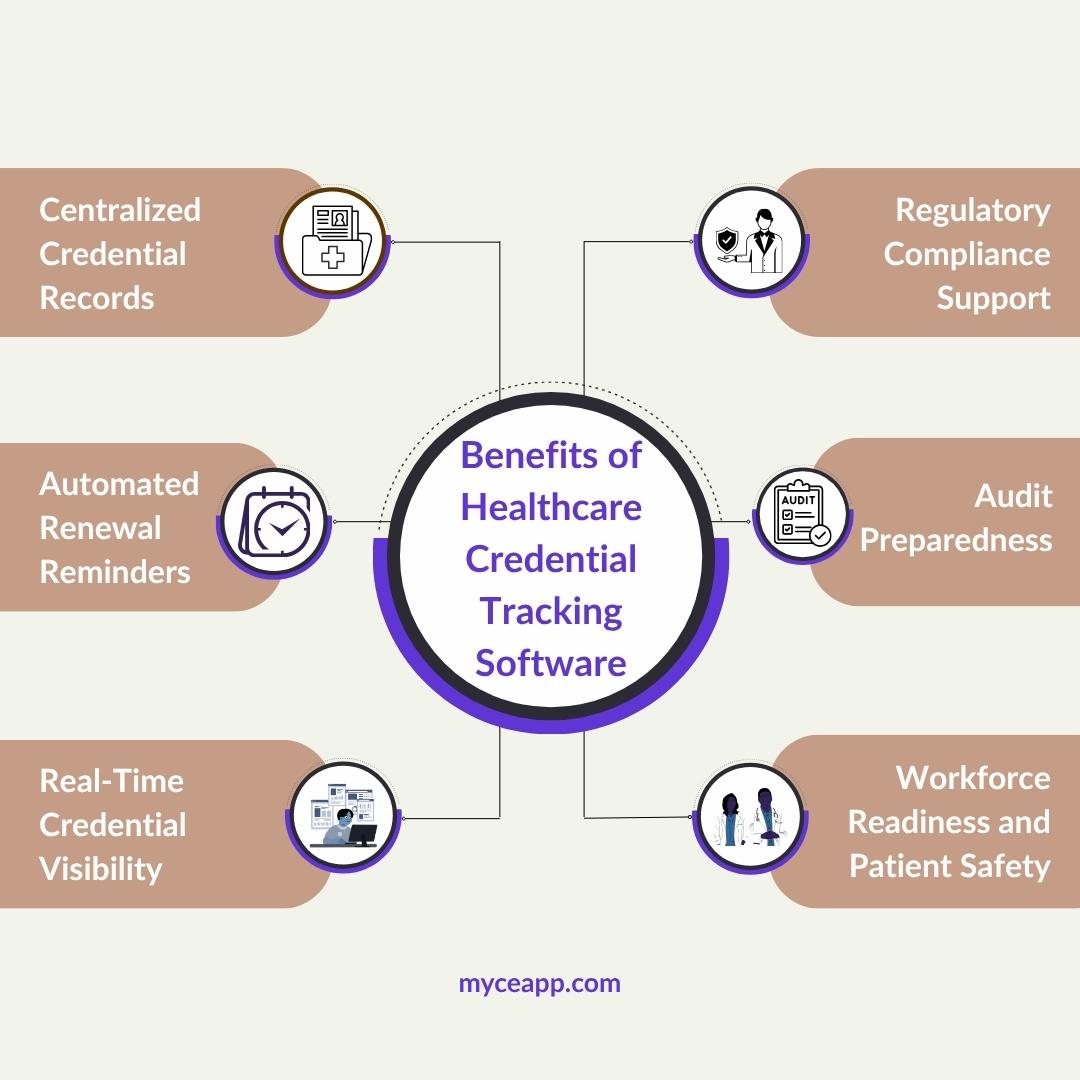
As illustrated earlier in this post, managing credential requirements manually becomes increasingly difficult as healthcare organizations grow. Healthcare credential tracking software simplifies the process through the following capabilities:
Centralized Credential Records: Stores credential details and supporting documentation in one system, making records easier to maintain and access.
Real-Time Credential Visibility: Provides a clearer view of credential status across the workforce, helping teams identify missing documentation and upcoming deadlines.
Regulatory Compliance Support: Helps organizations monitor credential requirements and maintain records needed to demonstrate compliance with applicable regulations and accreditation standards.
Audit Preparedness: Makes credential information and supporting documentation easier to retrieve during audits and reviews.
Workforce Readiness and Patient Safety: Helps organizations identify expired or incomplete credentials so they can address issues that may affect practitioner eligibility and patient safety.
As credential requirements evolve and workforces grow, healthcare credential tracking software gives organizations a more organized and scalable way to monitor credentials, manage renewal deadlines, and support workforce compliance.
Next, the five reasons organizations most often invest in it.
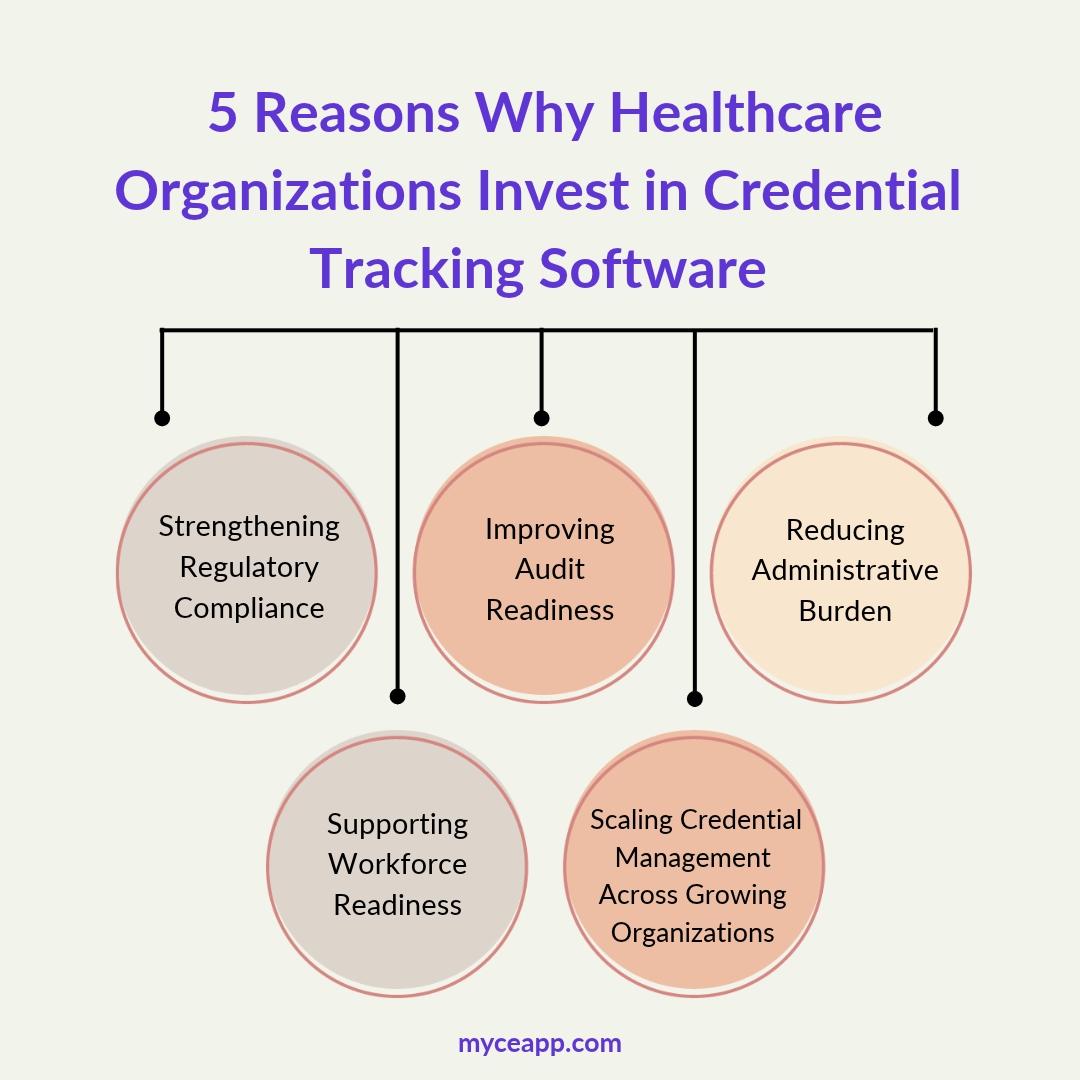
5 Reasons Why Healthcare Organizations Invest in Credential Tracking Software
Organizations most commonly turn to healthcare credential tracking software for the following reasons:
Reason #1: Strengthening Regulatory Compliance
Healthcare organizations need reliable processes for verifying practitioner qualifications and keeping required credentials current, and those requirements come from several directions and have varying consequences.
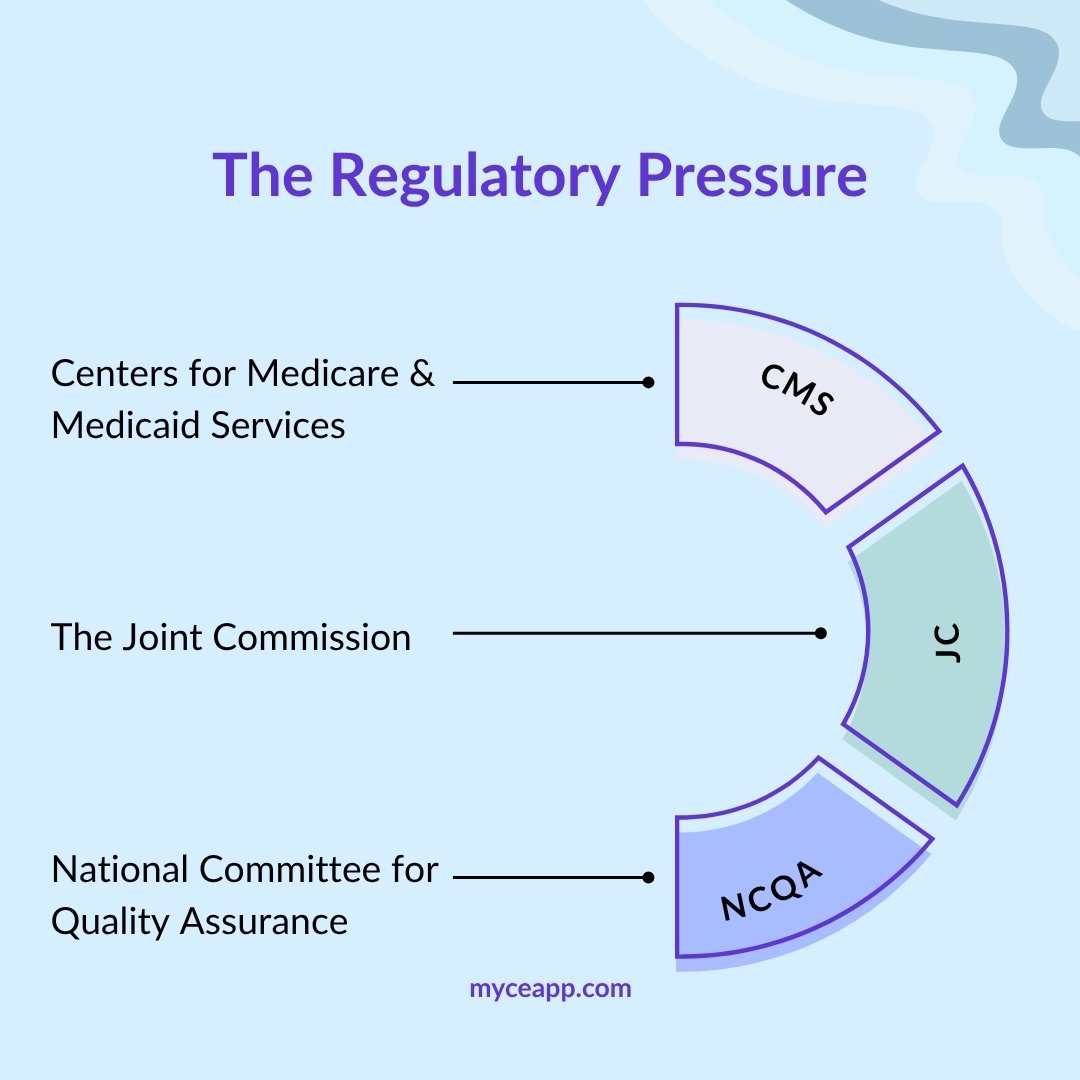
The Regulatory Pressure:
Centers for Medicare & Medicaid Services (CMS): Hospitals participating in Medicare and Medicaid must meet applicable Conditions of Participation. Under42 CFR § 482.22, the medical staff must examine the credentials of candidates for medical staff membership.42 CFR § 482.12 addresses the governing body’s responsibilities, including appointing members of the medical staff and granting clinical privileges.[3]
The Joint Commission: Its Standards Interpretation FAQ on primary source verification (PSV) states that completing PSV of licenses, certifications, and registrations is the responsibility of the accredited organization, not the licensed individual. Presenting a copy of a license, without evidence that the organization completed the verification, does not meet the intent of the requirement.[4]
National Committee for Quality Assurance (NCQA):NCQA calls credentialing “more than a ‘check the box’ regulatory burden” and “an essential safety component of the health care system.”[5]
How Credential Tracking Software Helps:
Monitor Credential Expirations: Identify licenses and certifications approaching their renewal dates.
Track Outstanding Requirements: Flag missing documents and incomplete credential records.
Maintain Consistent Oversight: Help credentialing teams monitor requirements across facilities and licensing jurisdictions.
Address Potential Gaps: Give administrators time to follow up on outstanding renewals or documentation.
These capabilities support credential oversight but do not replace required verification procedures or guarantee regulatory compliance, which ultimately depends on the organization to complete.
Reason #2: Improving Audit Readiness
Healthcare organizations may need to produce credentialing records during internal reviews, accreditation surveys, or external audits. Finding relevant documents and confirming that records are complete can take considerable time when information is scattered across files and systems.
How Credential Tracking Software Helps:
Retrieve Supporting Documents: Locate credential records without searching through multiple folders and email threads.
Review Credential Histories: Access available records of renewals, verifications, and status changes.
Identify Missing Information: Flag incomplete files before an audit or accreditation review.
Prepare Reports: Generate credential status reports when the platform supports reporting functionality.
These capabilities can reduce the effort required to prepare for reviews. However, audit readiness still depends on accurate records, appropriate policies, and consistent verification procedures.
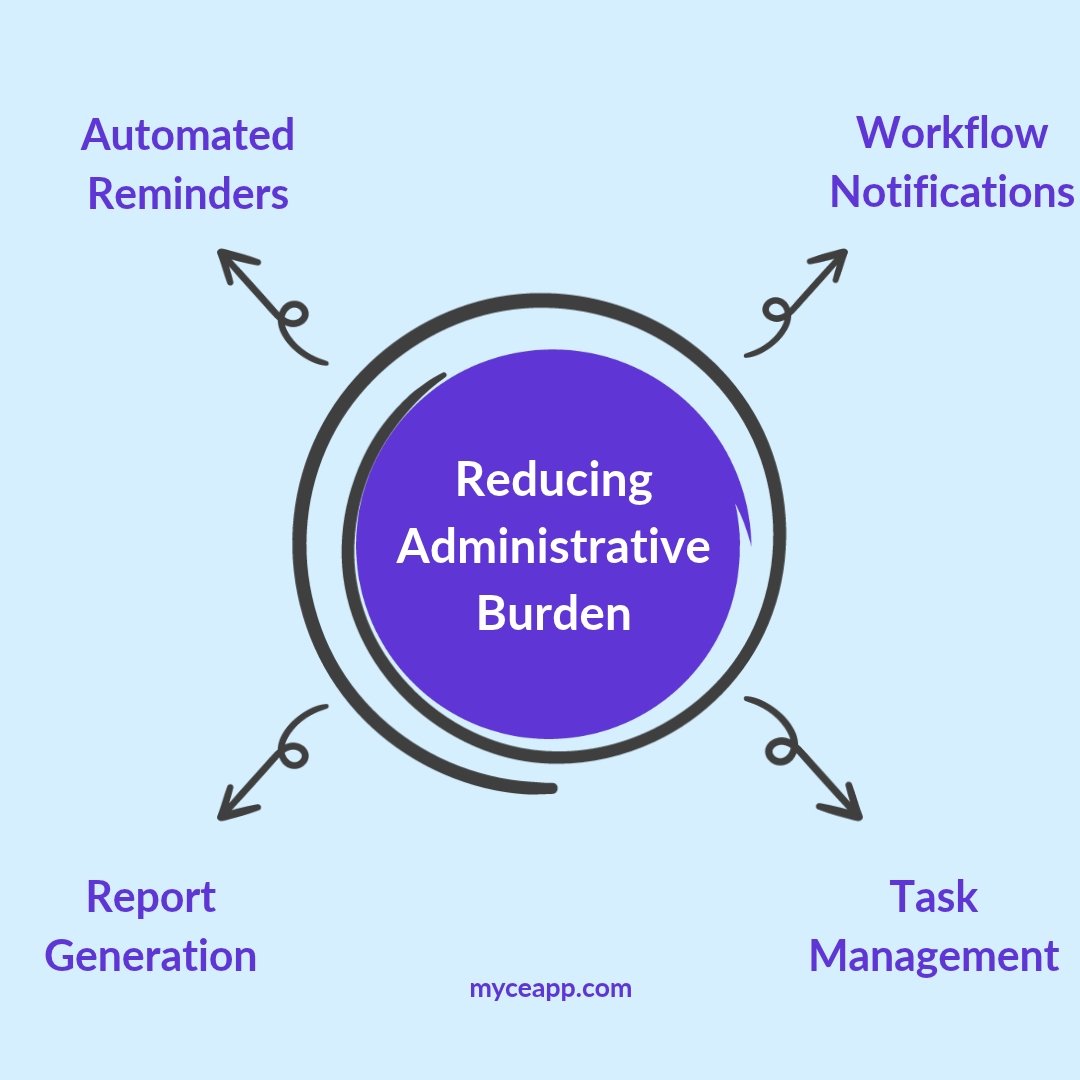
Credentialing teams spend time monitoring renewal dates, requesting updated documents, checking submissions, and following up with providers. These repetitive tasks can consume resources that could otherwise be used to resolve more complex credentialing challenges.
How Credential Tracking Software Helps:
Automated Reminders: Notify providers and administrators about upcoming deadlines.
Workflow Notifications: Alert relevant team members when documents or approvals require attention.
Task Management: Help staff prioritize pending verifications and incomplete records.
Report Generation: Reduce the need to compile credential status information manually.
By reducing repetitive work, organizations can give credentialing teams more time to handle edge cases, coordinate with providers, and resolve outstanding requirements. Actual time savings depend on the software’s capabilities and the organization’s existing processes.
Reason #4: Supporting Workforce Readiness
Healthcare organizations need appropriately qualified professionals to complete onboarding requirements and perform their assigned duties. Expired licenses, missing certifications, or outstanding verifications can delay onboarding and affect workforce planning.
When a clinician’s license or certification lapses, the organization that employs them can inherit the consequences. Our guide to what happens when healthcare certifications expire covers them in detail.
How Credential Tracking Software Helps:
Monitoring Upcoming Deadlines: Identify credentials that may require renewal before a provider’s planned start date or assignment.
Tracking Pending Requirements: Highlight incomplete documentation or verification tasks that could delay onboarding.
Supporting Workforce Planning: Give administrators visibility into credential-related issues that may affect provider availability.
Enabling Timely Follow-ups: Help teams address outstanding requirements before they cause avoidable delays.
These capabilities support better planning, but tracking software does not completely replace the verification and approval processes required before a provider can practice or receive clinical privileges.
Reason #5: Scaling Credential Management Across Growing Organizations
Maintaining consistent processes across a growing workforce can become increasingly difficult when each location relies on separate spreadsheets or manual procedures.
How Credential Tracking Software Helps:
Standardized Workflows: Apply consistent credential management procedures across departments and facilities.
Organization-Wide Reporting: Give authorized teams a broader view of credential status across locations and departments.
System Integrations: Connect with HR or provider management systems when supported, reducing duplicate data entry.
Scalable Processes: Accommodate growing provider volumes without relying entirely on manual tracking.
For expanding healthcare organizations, these capabilities can support more consistent oversight and coordination. The right platform should match the organization’s provider volume, reporting needs, integration requirements, and regulatory responsibilities.
Simplify Compliance With CE App
Discover how automated reminders, centralized documentation, and real-time reporting can reduce administrative work and keep your organization audit-ready. → Book a Demo Today
Who Should Use Healthcare Credential Tracking Software?
Healthcare credential tracking software is useful for organizations that need to verify, maintain, and monitor the qualifications of licensed healthcare professionals. It is particularly valuable when an organization manages multiple providers and works across several locations.
Many of the organization types listed below, including hospitals, ambulatory surgical centers, home health agencies, and long-term care facilities, must also meet the CMS Conditions of Participation or Conditions for Coverage to take part in Medicare and Medicaid, adding to the complexity of their reporting and regulatory obligations.[3]
Hospitals and Health Systems:Hospitals and health systems manage large clinical workforces across multiple departments and locations, often crossing state boundaries. Credential tracking software helps credentialing teams maintain provider records, monitor renewal dates, and keep documentation organized across locations.
Physician Groups and Multi-Specialty Clinics: Medical practices need to track physician licenses, board certifications, continuing education requirements, and other qualifications relevant to their roles. Such tracking software helps administrative teams manage these records as the practice adds providers or expands into new specialties.
Healthcare Staffing Agencies: Staffing agencies must confirm that healthcare professionals meet the requirements of the roles and facilities to which they are assigned. Credential tracking software helps recruiters and compliance teams monitor expiring credentials and identify missing documentation before a placement.
Ambulatory Surgery Centers and Outpatient Facilities: Outpatient facilities need to maintain appropriate provider credentials and documentation for clinical services and facility requirements. Centralized tracking helps staff review credential status and identify records that need renewal or follow-up.
Long-Term Care and Home Healthcare Providers: These organizations may employ or coordinate professionals working across different facilities or patients’ homes. Credential tracking software helps administrators monitor required licenses, certifications, and training records across a distributed workforce.
Behavioral Health and Telehealth Organizations: Behavioral health and telehealth providers may work across multiple jurisdictions, making it important to track applicable professional licenses and renewal requirements. A centralized system can help organizations monitor credentials by provider, location, and permitted scope of practice.
Academic Medical Centers and Teaching Hospitals: Academic medical centers coordinate credential records for attending physicians, residents, fellows, and other clinical professionals. Effective tracking software can help administrators organize records and monitor requirements across departments and training programs.
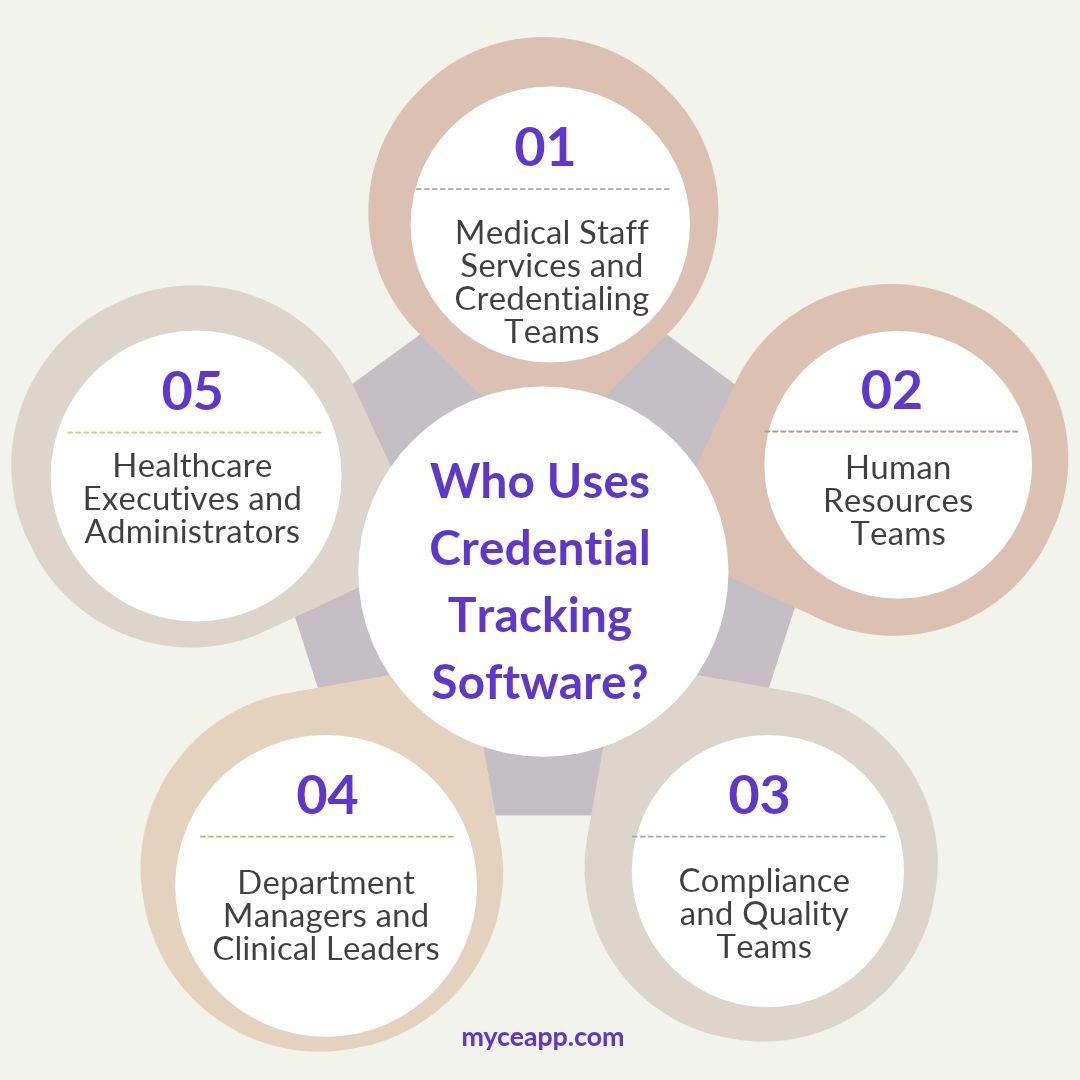
Who Within These Organizations Uses Credential Tracking Software?
Although credential tracking software supports the wider organization, several teams may benefit disproportionately from it in their day-to-day schedules:
Medical Staff Services and Credentialing Teams: Verify qualifications, maintain provider files, and track credential status.
Human Resources Teams: Coordinate employment documentation and monitor relevant license or certification requirements.
Compliance and Quality Teams: Review credential records and identify missing, expired, or incomplete documentation.
Department Managers and Clinical Leaders: Check whether providers have the required credentials for their assigned roles.
Healthcare Executives and Administrators: Review credentialing status and workforce-level reports to support operational decisions.
When Is Credential Tracking Software Most Useful?
An organization may benefit most from dedicated software when it:
Manages a large or rapidly growing provider workforce.
Operates across multiple facilities, departments, or states.
Has frequent license renewals, certification deadlines, or recredentialing cycles.
Relies on spreadsheets, email reminders, or separate files to maintain records.
Needs a consistent way to review credential status across teams or locations.
Healthcare credential tracking software is best suited to organizations that need a reliable, repeatable process for managing provider qualifications. The appropriate solution depends on the credentials being tracked, the complexity of the workforce, and whether the organization also needs broader credential verification, privileging, or payer enrollment capabilities.
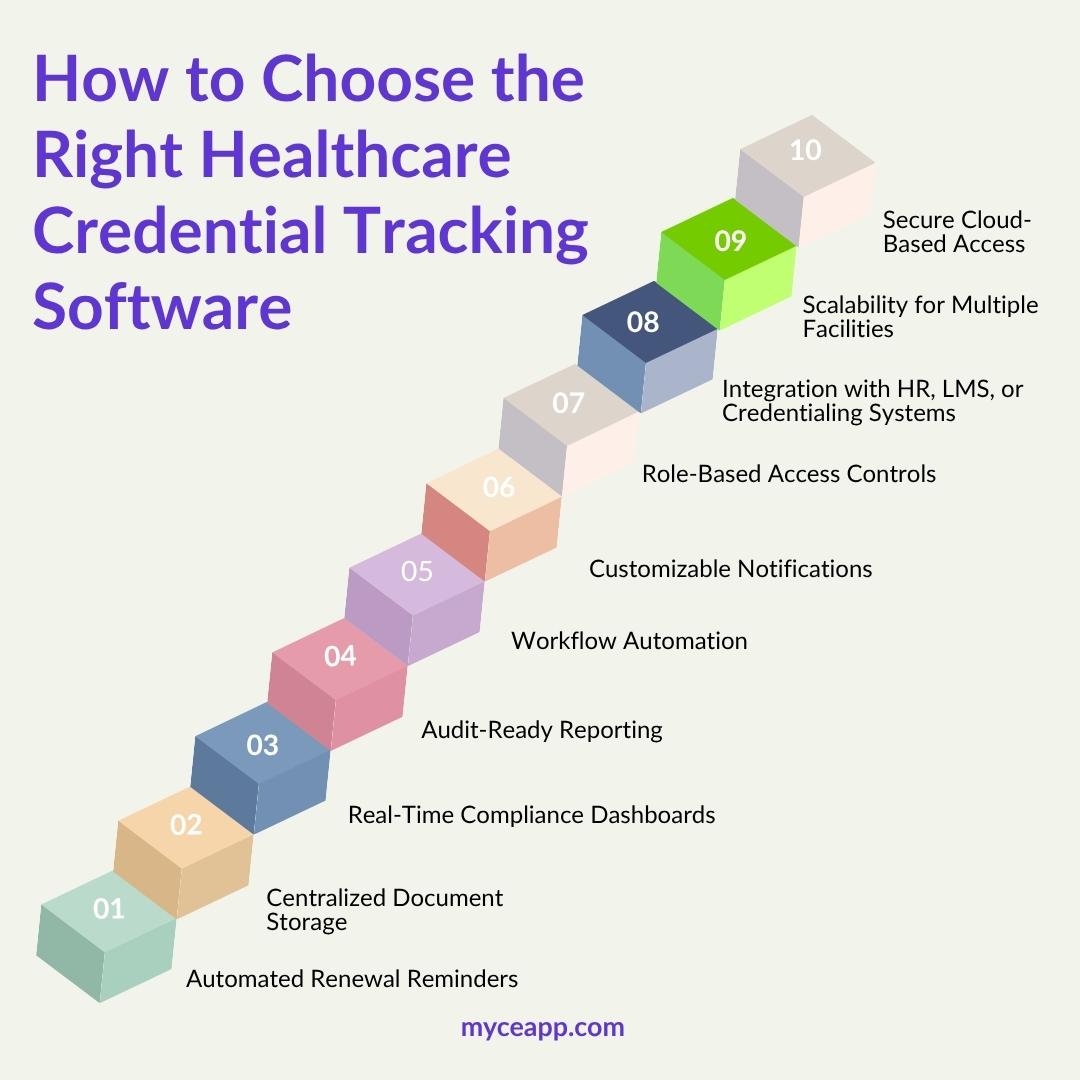
How to Choose the Right Healthcare Credential Tracking Software
When evaluating healthcare credential tracking software, organizations should look beyond basic license tracking and consider features that support long-term compliance and operational efficiency.
Key Capabilities Include:
Automated Renewal Reminders
Centralized Document Storage
Real-Time Compliance Dashboards
Audit-Ready Reporting
Workflow Automation
Customizable Notifications
Role-Based Access Controls
Integration with HR, LMS, or Credentialing Systems
Scalability for Multiple Facilities
Secure Cloud-Based Access
Choosing software that aligns with current needs while supporting future organizational growth can help simplify credential management as workforce requirements evolve.
Conclusion
Managing workforce credentials has become significantly more complex as healthcare organizations expand across specialties, facilities, and regulatory jurisdictions. Professional licenses, certifications, continuing education requirements, and credentialing documentation all require continuous oversight to maintain compliance and support uninterrupted patient care.
While manual tracking methods may work for smaller organizations, they often become difficult to sustain as workforce size and regulatory complexity increase. Credential tracking software helps healthcare organizations centralize credential records, automate routine administrative tasks, improve audit readiness, and maintain greater visibility into workforce compliance.
By adopting a proactive approach to healthcare credential tracking, organizations can reduce administrative burden, strengthen compliance efforts, and help healthcare professionals continue to meet the qualifications required to deliver safe and high-quality care.
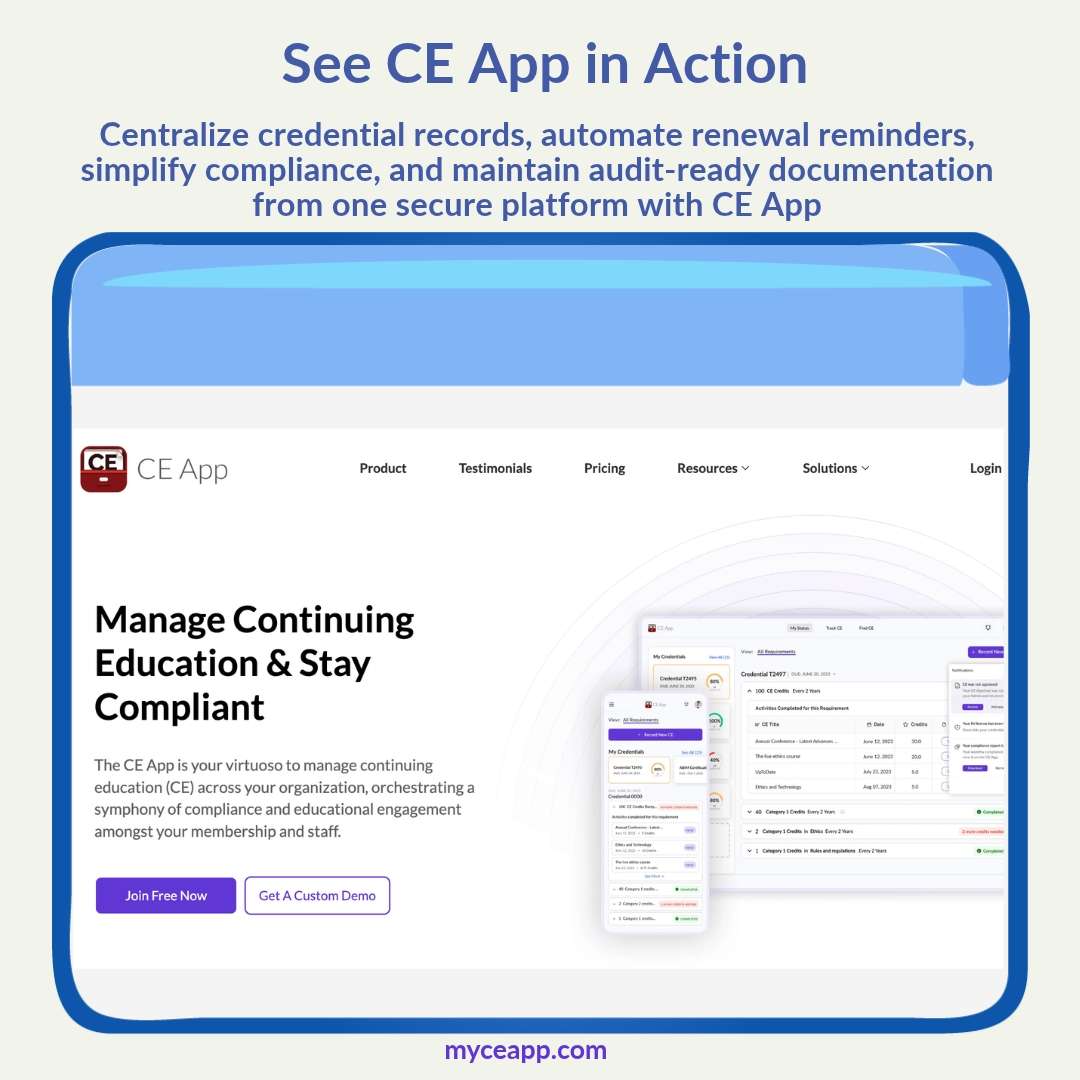
See CE App in Action
Managing workforce credentials does not have to be complicated. CE App helps healthcare organizations centralize credential records, automate renewal reminders, simplify compliance, and maintain audit-ready documentation from one secure platform.
Whether you manage a single facility or a growing healthcare network, CE App gives your team the tools to stay organized, compliant, and prepared for growth.
Ready to streamline your credential tracking process?
Request a personalized demo today and discover how CE App can help your organization improve efficiency, strengthen compliance, and simplify credential tracking.
References
Federation of State Medical Boards (FSMB). Continuing Medical Education Requirements (2026).
Healthcare credential tracking software is a software tool that helps healthcare organizations monitor professional licenses, certifications, continuing education requirements, renewal dates, and supporting documentation. It provides a centralized view of credential status, helping teams identify upcoming expirations and credentials that require follow-up.
Manual credential tracking relies on spreadsheets, calendars, emails, or paper records to monitor qualifications and renewal dates. Healthcare credential tracking software organizes this information in one place and can provide automated reminders, status updates, and reports, depending on its features.
Healthcare organizations should look for features such as centralized credential records, automated expiration reminders, document storage, credential status tracking, reporting, and configurable notifications. Organizations managing multiple facilities or large provider teams may also need location-based tracking, role-based access, and integration with existing systems.
Healthcare credential tracking software supports compliance efforts by helping organizations monitor credential expiration dates, maintain supporting documentation, and identify missing or outdated records. These capabilities help teams follow up on potential gaps and prepare for audits, although the software does not guarantee compliance on its own.
Healthcare organizations use credential tracking software to monitor workforce credentials more consistently, reduce manual tracking tasks, and identify upcoming renewals or missing documentation. It is particularly useful for organizations managing many healthcare professionals, multiple locations, or frequent credential renewal deadlines.
The organization. For organizations accredited by The Joint Commission, completing primary source verification of licenses, certifications, and registrations is the organization’s responsibility, not the licensed individual’s, and a copy of a license without evidence of the organization’s verification does not meet the requirement’s intent. Clinicians maintain their own credentials; the organization has to prove them.
Learn more about the CE App
See how your organization can use CE App to increase revenue and improve continuing education compliance.